Posts Tagged With: South America

The Calamity in Calama

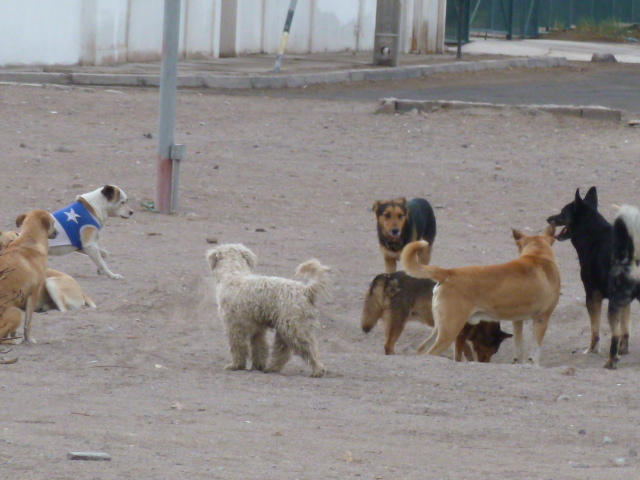
The dog on the left with the blue shirt and white star was attacked and chased into submission by these street dogs that invaded his neighborhood. Then the "alpha male dog" turned on another dog in the pack in what turned into a vicious dog fight I witnessed.

What you are seeing is a dog fight between two dogs of the same pack. The dog on the bottom got the worst of it and limped away.
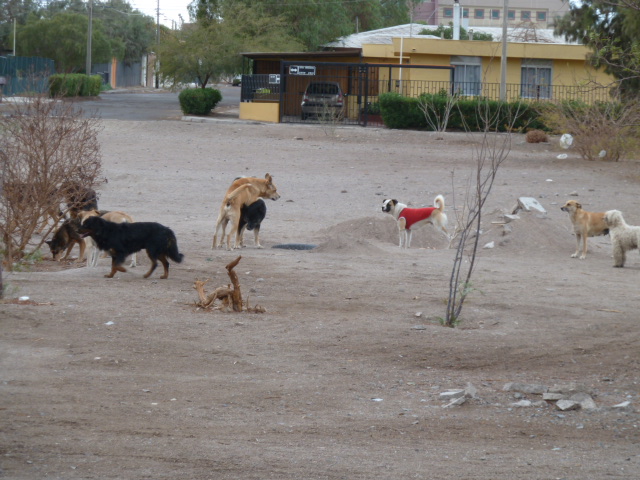
The dog in the middle on top of the other dog is apparently leader of the pack and asserting his dominance as the poor neighborhood dog wearing a sweater approaches. He's in for a nasty fight.


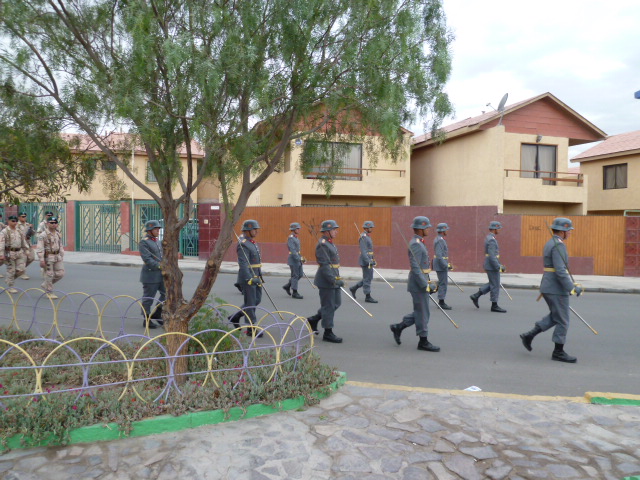
YOU DON’T WANT TO TANGLE WITH SOLDIERS WHO WEAR THESE SUNGLASSES: Chilean troops based in Calama march through the streets, ready to defend the homeland.

The town is called Calama, but they may as well have named it Calamity. Or at least that’s the impression inhabitants have given in the short time I’ve been here.

In less than a week in this dusty mining town in northern Chile, I’ve been warned to be careful about packs of street dogs that behave more like wolves on the attack; tricky gypsy women out to relieve the unsuspecting of cash and credit; roving band of drug-addicted robbers looking violently take possession of other people’s valuables; of contaminated tap water with high levels of stuff that can kill you; on and on. Who would think a decision to come to Calama to teach English would be potentially hazardous to my health? Well, living life is a big hazard in of itself, isn’t it? I’ll just continue to hope my Guardian Angels have not abandoned me, thinking “kid, no way we are spending a minute in this Podunk town!”  🙂

For those of you who aren’t keeping up – and God only knows why you are not! – Calama kind of just happened. I was in Peru on my way to Bolivia. I had La Paz on my mind, its mountains, the salt flats of Uyuni, and the landscape and people I had heard so much about. Ready for Bolivia I was. Then the good people at the International Center contacted me to ask if I would be interested in joining their team of English teachers for at least the next six months. My task would be to teach English to executives at one of the local copper mines. After some thought, and with South America in the throes of winter, I accepted the offer. The idea is to wait out winter here and continue travel in nicer summer weather.
A word about the region’s copper mines: Chile is the world’s largest copper producer and boasts the world’s largest copper mine. The mines are in the northern part of the country and Calama is a town that sprung from that mining production. The mines date back to pre-Inca times. In other words, the indigenous people that lived in the region pulled copper from the area long before the Incas and the Spaniards came to the area. The mines were the source of wars between Chile, Peru and Bolivia with archrival Argentina threatening to also attack Chile. Argentina has a longstanding beef with Chile over some southern islands. Not to mention their rivalry over futbol 🙂 Chile managed to kick serious butt and in the process took land from Peru and Bolivia. To the victor go the spoil, right?

In that so-called War of the Pacific, Chile kept several cities and towns from Bolivia and Peru. One of those towns it took from Bolivia was Calama. The Chileans had marched all the way to Peru’s capital, Lima, and contend they could have kept even more territory. The Peruvians and Bolivians still hold a grudge with Chile over the lost territories, especially Bolivia which lost its access to the Pacific Ocean. Chile maintains a very strong army just in case its neighbors try anything foolish. Most military experts note that Chile would handily beat back any aggression. They are probably right. Chile maintains a military contingency in the north and I saw them marching through the streets and they looked like a fierce force.

Let sleeping dogs lie

Anyway, there’s no soft way to put it: Calama is an ugly city. Some say it’s not even a city, that it’s an encampment of miners and mining-related industries. A Chilean colleague at the International Center told me that I picked the ugliest city in Chile to visit first. She said the reason the city is so ugly is because it grew out of a collection of substandard houses and buildings to house and provide services to the miners. Nobody was thinking aesthetics.

One of the first questions I’m asked by residents of Calama is what I think of their city. That question is usually followed with a statement from them that it’s okay to say it’s ugly because it is. Clearly some of them don’t think much of the place. I for one think I can survive here six months. I don’t mind that the place is ugly. I care more about the people and how they treat me, and so far, people have been very friendly.

Now, if only those rabid dogs, those street thugs, those tricky-dickey gypsies and the carcinogenic water would leave me be.  🙂

Categories: posts | Tags: , , , , , , , , | 2 Comments

What Has Stuck With Me About This Place Peru

EAT, SMILE, EAT, REPEAT:

The New York Times said it a bunch of times. Other newspapers and magazines have been saying it. And a gazillion trillion others have continued to echo it: Peru has the best cuisine in the world! But don’t listen to any of them. What do they know? Listen to me. It’s true! I may not be able to cook a lick, but I know food that goes beyond the ordinary when I see and taste it. I have not had one bad meal in Peru. You just have to know where to look, but you don’t have to look very hard or even far. Just about anywhere you turn in Peru, you will bump into great cooking. People who know a great deal more about food than I do credit Peru’s diverse cultures that have borrowed from each other – a spice or two here, a cooking method there – to create unique dishes and presentations. So Europe meets Africa meets Asia meet Indigenous meet in Peru! And Le Cordon Bleu Peru continues to crank out skilled chefs in the great tradition of the acclaimed Gaston Acurio. I had the pleasure of dining at two of Acurio’s restaurants – Tanta in Lima and ChiCha in Cuzco – and it made me happier than a fat kid in a bakery. The dishes were a burst of flavors. At ChiCha  where I struggled to get a table, I had a seafood risotto that was killer. I ate every grain and wanted more. And just as ChiCha, I found Tanta purely by accident: I was walking around looking for a place to eat and noticed the crowds. If you don’t take my word for it, listen to the New York Times and the gazillion trillions. And the other newspapers and magazines that have continued to extoll Peru as a gastronomic powerhouse. It truly is.

WITHOUT ME YOU ARE NOTHING!: 

Peru has a race and class problem that has led to a bit of an  identity crisis. You see, white, wealthier Peruvians tend to look down at the Afro-Peruvian and indigenous populations. They don’t value them. If anything, they treat them as a thing to be scorned.  Of course I’m not talking about all Euro-Peruvians, those with Spanish backgrounds. Just some. It’s not talked about much. But ask any Peruvian about it and they will open up about it. A great deal of this disdain is reserved for the indigenous population. You hear the word “cholo” directed at the indigenous population and you know it’s not exactly a compliment.  This has lead to young descendants of the Incas denying their heritage. Some refuse to learn or speak Quechua. They are conflicted about who they are. They want to be identified as anything but from indigenous stock. And yet, were it not for their culture and the heritage that their ancestors built, Peru would lose a huge chunk of its tourism. You think the tourists are coming to see white Euro-Peruvians dressed in their suits and ties? No, they want to take home photos posing with indigenous people in Machu Picchu. Snap your finger and rid yourselves of the indigenous populations and Peru would be just another mediocre country known for not very much.  Well, except it’s good eats J Anyway. It’s time the indigenous populations of Peru – Cuzco, by the way, is somewhat of an exception – start fully embracing who they are and that white Peruvians stop painting them as low class nothings.

THAT’S SO RUDE!:

Okay, so I completely understand that what works for the United States and other supposed “civilized” and “refined” countries doesn’t necessarily work in other countries where chaos is somewhat of a norm. But rude to me is rude. If I’m standing in a crowd watching a parade and you come along and shove me aside to get a view of the parade with not an “excuse me” or “sorry” you are rude! rude! rude! Pushing and shoving people to take their spot was a daily occurrence in Cuzco. I thought at first it was an individual and isolated thing but it just kept happening. So I asked several Peruvians from Cuzco about it and they all said the same thing. That they were aware of this rude behavior and that it was due in part to people simply not being taught manners at home. It’s accepted behavior. Other outsiders – i.e. visitors – experienced this and also wondered about it. Sorry to say this behavior was largely in the indigenous population, i.e., poor and largely un- or miseducated.  Now, I’m taller than most in Peru, so being shoved to the back didn’t trouble me much. I could still get a good view over the people in front of me. But still, manners, manners!

THE PRICE IS WRONG!:

Cuzco is so expensive  it has priced out even Peruvians. Many Peruvians are poor and can’t afford to travel beyond their borders. But I found it interesting that many Peruvians can’t afford to visit Machu Picchu and never have. The entrance fee, the transportation and other related costs put Machu Picchu and other Inca sites out of reach. I understand that governments try to squeeze every dollar or euro out of tourists, but they some seriously need to evaluate the money they ask their citizens to pay. This is especially true of Peru. One of the employees at my hotel said he had been to Machu Picchu only because someone else paid the costs, but his wife – a Peruvian born and raised in Cuzco – had never been to the site. They simply could not afford it. Just about every South American country has two or three different prices – one higher price for tourists, one for citizens of the country and one for locals. Galapagos, for instance, has such a system in which locals pay no entry fees or very little. Peru, it’s time you get a clue.

WARTS AND ALL:

With all its faults, Peru is magical, breathtaking, beautiful, fun, and rich in Pre-Columbian and colonial history. And the civilization that the Incas built is everywhere, not just Machu Picchu. I loved Peru!

Categories: posts | Tags: , , , , , , , , , | 3 Comments

Water And Laser Show

If you come to Lima, Peru, you must visit Parque De Las Aguas. It’s a beautiful park with dozens of spectacular water fountains that delight visitors with creative displays of water and light set to music. The highlight is a phenomenal water and laser show choreographed to music. I was treated to the show by friends of my friend Marco and was so blown away by it I returned the following night with some new friends I met in Lima, Fabio and Regina of Sao Paolo, Brazil. The second time around I filmed the entire show. Although my camera does not do this entertaining event justice, hopefully it gives you some idea of what it’s all about. Enjoy!


Categories: asides | Tags: , , , , , , , , | Leave a comment

Blog at WordPress.com.