

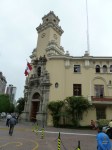
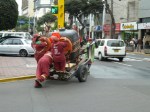
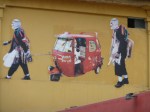
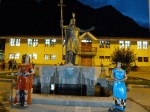
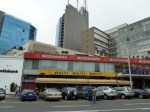
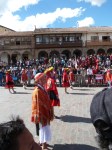
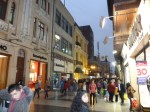
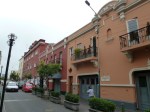
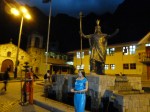
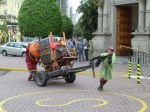
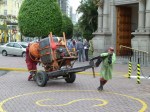
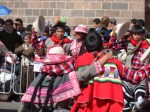
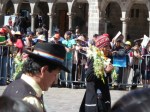
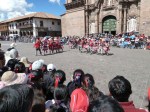
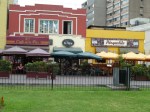
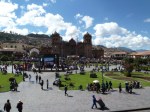
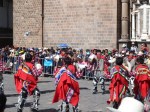
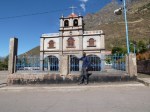
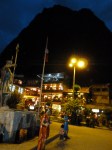
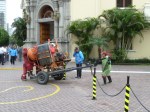
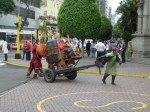
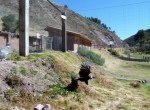
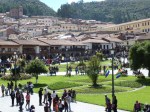
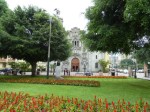
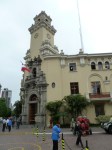
A section of the center of Calama, Chile, on a Sunday.
Today is Independence Day in the United States, the day the most powerful nation on Earth celebrates its independence from England. Today marks 235 years of that self-determination.
While most Americans will be celebrating with a day off from work and with picnics, cookouts and just having fun at music concerts and fireworks displays, I will be reporting for work as an English instructor in Northern Chile. I will be working for an agency – the International Center – teaching English to employees and executives of a company that operates the largest copper mine in the world. This bit about the company from www.visitchile.com:
“Chuquicamata is known around the world because of its copper production (activity that preceeds the Inca Empire). It´s an industry that began circa 1882, although it started operating properly in 1911 when US capitals finished its construction. Today, the production reaches the 630 tons of fine copper every year. The Chuquicamata Mine belongs to CODELCO (Copper Corporation), the most important Chilean mineral industry, and it`s the biggest copper mine in the world (4,3 kilometers long, 3 kilometers wide and 800 meters deep). The mine has a balcony for visitors, who can also learn about copper procedures.”
Calama is also a gateway to the Atacama Desert, known as the driest place on Earth. It’s a fascinating place, with geysers and hot springs. I of course intend to visit.

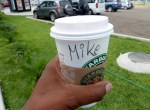
New, more modern business emerging outside of downtown. Fantastic! But where's the Starbucks? 🙂
I will be working in Calama for at least the next six months. So this desert town will be my home until December. I will share a house with several other teachers (I’m not quite sure how many – perhaps three or four) but I will have my own room. Housing, health care, utilities, including Internet, are all provided free of charge by International Center, which has contracts with dozens of businesses and corporations around the world to provide language and translation services.
So what does this mean for my three-your journey around the world? Well, I see it as just a pause, an opportunity to stick out winter in one place and resume travel across the rest of South America in summer. It’s a chance to catch my breath. To stay in one place longer and learn about the people and culture. It’s a great opportunity to try my hand at something other than journalism. And it’s good for my resume, too, should other teaching opportunities in other parts of the world arise.
I’m not sure what my six months in Calama will be like. For someone used to big cities like New York and Miami, Calama is a small town. I took a walk around the town on Sunday and it looked like a ghost town. Just about every business was closed. And the few people who were out and about just stared and probably wondered what the heck was I doing in this dust bowl of a town. In the ice cream parlor the woman behind the counter asked if I was Colombian. Her eyes lit up when I said from the United States. She seemed pleased to see someone from a continent away and went out of her way to be helpful and to share information about little ol’ Calama.
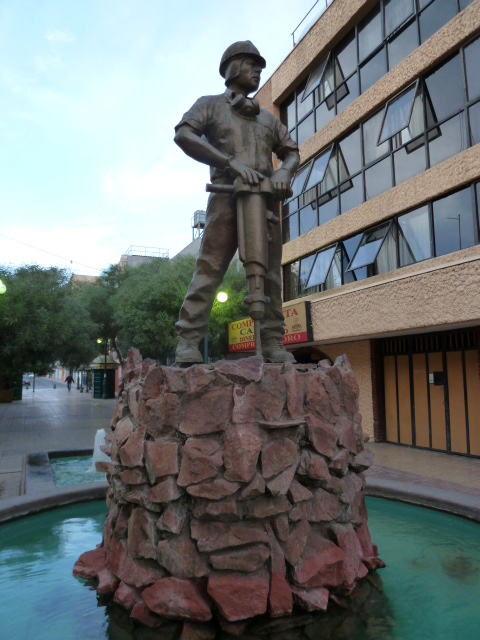
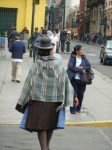
This is a mining town! And evidence of that is everywhere. The men in town look like miners, and the women, well... 🙂
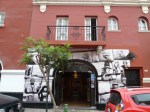
I also stopped in one of the local barbershops. I had walked past it and notice the three people inside looked so bored. I told them so and they laughed. They said things are kind of slow in town on Sundays. I also talked to two young Chilean soldiers sitting on a park bench. They said they had been assigned to Calama and they had been in town two months. They said they were from the capital, Santiago, where there is much more hustle and bustle. But Calama had a couple of clubs and on Fridays and Saturdays there were at least two nightclubs and several bars. Calama also is growing – or I should say growing up. It has a relatively new rather swanky Sonesta Hotel and a casino next door. A shopping mall is just three blocks away. And several very cool new businesses and restaurants are set to open any day now. The center of town is not exactly an ode to modernity. All the buildings are rather old and it reminds me of an old frontier town, like the ones in Western movies in which desperados ride in to town on horses looking for a couple of shots of whisky and a woman named Kitty in the saloon. In fact, as I walked through town, one of the local drug addicts pretending to mind cars for some change, first asked if I needed to park my car. Funny, since I was on foot. I said no, then he asked if I was looking for the company of a woman. Apparently, the drug addict/parking attendant is also part-time pimp. I told him I was just checking out the town. I had been drawn to that corner because I saw that there was a Blockbuster. Good heavens! Maybe there’s a Starbucks, too! Fat chance!

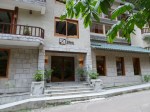
The Sonesta Hotel Calama, pricey modernity but modernity nonetheless
So today, Independence Day for my fellow Americans is Orientation Day for me. I report to meet the International Center staff, fill out presumably lots of paperwork, make arrangements for a medical exam (mandatory for employment), and more paperwork to get my Chilean work visa. Not sure if today I will meet my roommates. Just hope they’re the kind not to mess with my stuff! (I joke 🙂
My friend Brian Tarcy, ever the jokester, asked if now the blog will be known as Mike Tends To Work. Funny, Brian. No, as I consider this venture all part of my travel experience. And I still intend to travel to nearby places on my free time. Bolivia is but a bus ride away. The rest of Chile, too. I will bring you my work and travel adventures here. Several days a week I will have to travel for work anyway, to the mine, where I will conduct my lessons. The mine is about 16 kilometers away from Calama. Those bus trips should be interesting. But more interesting, I think, will be this six-month journey. Let’s see how it goes.

































































































































































































 Mike Tends To Travel
Blah blah blah (Comments)