Posts Tagged With: United States

I Put My Travels On A Long Pause To Take A Job In Chile

A section of the center of Calama, Chile, on a Sunday.

Today is Independence Day in the United States, the day the most powerful nation on Earth celebrates its independence from England. Today marks 235 years of that self-determination.

While most Americans will be celebrating with a day off from work and with picnics, cookouts and just having fun at music concerts and fireworks displays, I will be reporting for work as an English instructor in Northern Chile. I will be working for an agency – the International Center – teaching English to employees and executives of a company that operates the largest copper mine in the world. This bit about the company from www.visitchile.com:

“Chuquicamata is known around the world because of its copper production (activity that preceeds the Inca Empire). It´s an industry that began circa 1882, although it started operating properly in 1911 when US capitals finished its construction. Today, the production reaches the 630 tons of fine copper every year. The Chuquicamata Mine belongs to CODELCO (Copper Corporation), the most important Chilean mineral industry, and it`s the biggest copper mine in the world (4,3 kilometers long, 3 kilometers wide and 800 meters deep). The mine has a balcony for visitors, who can also learn about copper procedures.”

Calama is also a gateway to the Atacama Desert, known as the driest place on Earth. It’s a fascinating place, with geysers and hot springs. I of course intend to visit.

New, more modern business emerging outside of downtown. Fantastic! But where's the Starbucks? 🙂

I will be working in Calama for at least the next six months. So this desert town will be my home until December. I will share a house with several other teachers (I’m not quite sure how many – perhaps three or four) but I will have my own room. Housing, health care, utilities, including Internet, are all provided free of charge by International Center, which has contracts with dozens of businesses and corporations around the world to provide language and translation services.

So what does this mean for my three-your journey around the world? Well, I see it as just a pause, an opportunity to stick out winter in one place and resume travel across the rest of South America in summer. It’s a chance to catch my breath. To stay in one place longer and learn about the people and culture. It’s a great opportunity to try my hand at something other than journalism. And it’s good for my resume, too, should other teaching opportunities in other parts of the world arise.

I’m not sure what my six months in Calama will be like. For someone used to big cities like New York and Miami, Calama is a small town. I took a walk around the town on Sunday and it looked like a ghost town. Just about every business was closed. And the few people who were out and about just stared and probably wondered what the heck was I doing in this dust bowl of a town. In the ice cream parlor the woman behind the counter asked if I was Colombian. Her eyes lit up when I said from the United States. She seemed pleased to see someone from a continent away and went out of her way to be helpful and to share information about little ol’ Calama.
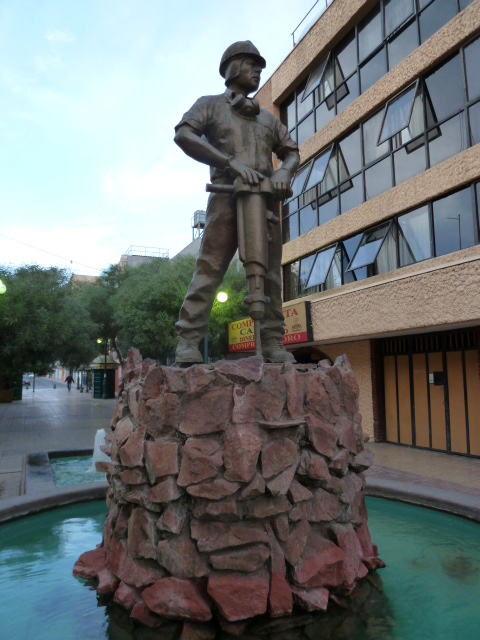
This is a mining town! And evidence of that is everywhere. The men in town look like miners, and the women, well... 🙂

I also stopped in one of the local barbershops. I had walked past it and notice the three people inside looked so bored. I told them so and they laughed. They said things are kind of slow in town on Sundays. I also talked to two young Chilean soldiers sitting on a park bench. They said they had been assigned to Calama and they had been in town two months. They said they were from the capital, Santiago, where there is much more hustle and bustle. But Calama had a couple of clubs and on Fridays and Saturdays there were at least two nightclubs and several bars. Calama also is growing – or I should say growing up. It has a relatively new rather swanky Sonesta Hotel and a casino next door. A shopping mall is just three blocks away. And several very cool new businesses and restaurants are set to open any day now. The center of town is not exactly an ode to modernity. All the buildings are rather old and it reminds me of an old frontier town, like the ones in Western movies in which desperados ride in to town on horses looking for a couple of shots of whisky and a woman named Kitty in the saloon. In fact, as I walked through town, one of the local drug addicts pretending to mind cars for some change, first asked if I needed to park my car. Funny, since I was on foot. I said no, then he asked if I was looking for the company of a woman. Apparently, the drug addict/parking attendant is also part-time pimp. I told him I was just checking out the town. I had been drawn to that corner because I saw that there was a Blockbuster. Good heavens! Maybe there’s a Starbucks, too! Fat chance!

The Sonesta Hotel Calama, pricey modernity but modernity nonetheless

So today, Independence Day for my fellow Americans is Orientation Day for me. I report to meet the International Center staff, fill out presumably lots of paperwork, make arrangements for a medical exam (mandatory for employment), and more paperwork to get my Chilean work visa. Not sure if today I will meet my roommates. Just hope they’re the kind not to mess with my stuff! (I joke 🙂

My friend Brian Tarcy, ever the jokester, asked if now the blog will be known as Mike Tends To Work. Funny, Brian. No, as I consider this venture all part of my travel experience. And I still intend to travel to nearby places on my free time. Bolivia is but a bus ride away. The rest of Chile, too. I will bring you my work and travel adventures here. Several days a week I will have to travel for work anyway, to the mine, where I will conduct my lessons. The mine is about 16 kilometers away from Calama. Those bus trips should be interesting. But more interesting, I think, will be this six-month journey. Let’s see how it goes.
Categories: posts | Tags: , , , , , , , | 1 Comment

What Has Stuck With Me About This Place Peru

EAT, SMILE, EAT, REPEAT:

The New York Times said it a bunch of times. Other newspapers and magazines have been saying it. And a gazillion trillion others have continued to echo it: Peru has the best cuisine in the world! But don’t listen to any of them. What do they know? Listen to me. It’s true! I may not be able to cook a lick, but I know food that goes beyond the ordinary when I see and taste it. I have not had one bad meal in Peru. You just have to know where to look, but you don’t have to look very hard or even far. Just about anywhere you turn in Peru, you will bump into great cooking. People who know a great deal more about food than I do credit Peru’s diverse cultures that have borrowed from each other – a spice or two here, a cooking method there – to create unique dishes and presentations. So Europe meets Africa meets Asia meet Indigenous meet in Peru! And Le Cordon Bleu Peru continues to crank out skilled chefs in the great tradition of the acclaimed Gaston Acurio. I had the pleasure of dining at two of Acurio’s restaurants – Tanta in Lima and ChiCha in Cuzco – and it made me happier than a fat kid in a bakery. The dishes were a burst of flavors. At ChiCha  where I struggled to get a table, I had a seafood risotto that was killer. I ate every grain and wanted more. And just as ChiCha, I found Tanta purely by accident: I was walking around looking for a place to eat and noticed the crowds. If you don’t take my word for it, listen to the New York Times and the gazillion trillions. And the other newspapers and magazines that have continued to extoll Peru as a gastronomic powerhouse. It truly is.

WITHOUT ME YOU ARE NOTHING!: 

Peru has a race and class problem that has led to a bit of an  identity crisis. You see, white, wealthier Peruvians tend to look down at the Afro-Peruvian and indigenous populations. They don’t value them. If anything, they treat them as a thing to be scorned.  Of course I’m not talking about all Euro-Peruvians, those with Spanish backgrounds. Just some. It’s not talked about much. But ask any Peruvian about it and they will open up about it. A great deal of this disdain is reserved for the indigenous population. You hear the word “cholo” directed at the indigenous population and you know it’s not exactly a compliment.  This has lead to young descendants of the Incas denying their heritage. Some refuse to learn or speak Quechua. They are conflicted about who they are. They want to be identified as anything but from indigenous stock. And yet, were it not for their culture and the heritage that their ancestors built, Peru would lose a huge chunk of its tourism. You think the tourists are coming to see white Euro-Peruvians dressed in their suits and ties? No, they want to take home photos posing with indigenous people in Machu Picchu. Snap your finger and rid yourselves of the indigenous populations and Peru would be just another mediocre country known for not very much.  Well, except it’s good eats J Anyway. It’s time the indigenous populations of Peru – Cuzco, by the way, is somewhat of an exception – start fully embracing who they are and that white Peruvians stop painting them as low class nothings.

THAT’S SO RUDE!:

Okay, so I completely understand that what works for the United States and other supposed “civilized” and “refined” countries doesn’t necessarily work in other countries where chaos is somewhat of a norm. But rude to me is rude. If I’m standing in a crowd watching a parade and you come along and shove me aside to get a view of the parade with not an “excuse me” or “sorry” you are rude! rude! rude! Pushing and shoving people to take their spot was a daily occurrence in Cuzco. I thought at first it was an individual and isolated thing but it just kept happening. So I asked several Peruvians from Cuzco about it and they all said the same thing. That they were aware of this rude behavior and that it was due in part to people simply not being taught manners at home. It’s accepted behavior. Other outsiders – i.e. visitors – experienced this and also wondered about it. Sorry to say this behavior was largely in the indigenous population, i.e., poor and largely un- or miseducated.  Now, I’m taller than most in Peru, so being shoved to the back didn’t trouble me much. I could still get a good view over the people in front of me. But still, manners, manners!

THE PRICE IS WRONG!:

Cuzco is so expensive  it has priced out even Peruvians. Many Peruvians are poor and can’t afford to travel beyond their borders. But I found it interesting that many Peruvians can’t afford to visit Machu Picchu and never have. The entrance fee, the transportation and other related costs put Machu Picchu and other Inca sites out of reach. I understand that governments try to squeeze every dollar or euro out of tourists, but they some seriously need to evaluate the money they ask their citizens to pay. This is especially true of Peru. One of the employees at my hotel said he had been to Machu Picchu only because someone else paid the costs, but his wife – a Peruvian born and raised in Cuzco – had never been to the site. They simply could not afford it. Just about every South American country has two or three different prices – one higher price for tourists, one for citizens of the country and one for locals. Galapagos, for instance, has such a system in which locals pay no entry fees or very little. Peru, it’s time you get a clue.

WARTS AND ALL:

With all its faults, Peru is magical, breathtaking, beautiful, fun, and rich in Pre-Columbian and colonial history. And the civilization that the Incas built is everywhere, not just Machu Picchu. I loved Peru!

Categories: posts | Tags: , , , , , , , , , | 3 Comments

After Almost 100 Years, Comes An Emotional Return

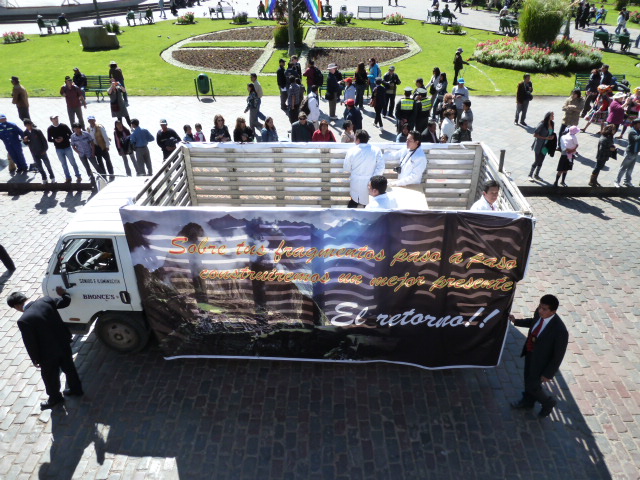
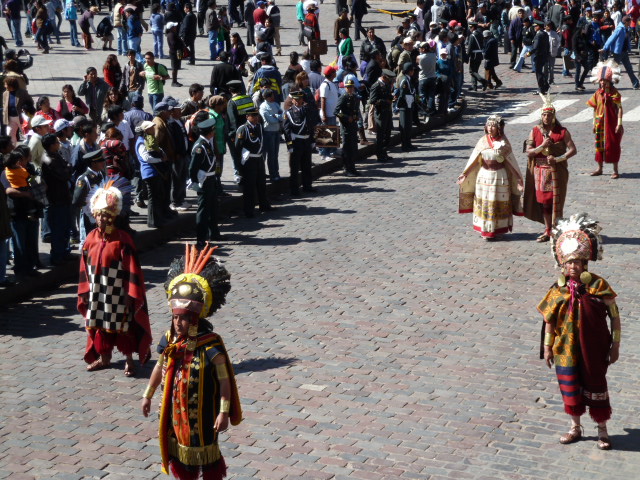
A proud people enter Plaza de Armas square, paying homage to their ancestors. They walk behind trucks carrying artifacts and bones of their Inca ancestors that were taken to the United States

On a guided tour, somewhere among the hand-sculpted stone wall remains of the fabled Machu Picchu, Jonatan the tour guide decided that I the American would be the perfect target for jokes. He asked if I had ever been to Yale University. Yes, I have, I said. Next time you go, he said, please ask when our Inca treasures will be returned.

Jonatan had spent a good part of the tour recounting Inca history from their early rule in the Peruvian valley and dominance across the continent to their internal powerful struggles that hastened their brutal defeat at the hands of Spanish conquistadors.

When he got to 1911 and the arrival at Machu Picchu of Hiram Bingham, Jonatan made a point to note that it was historically inaccurate to say that Bingham had “discovered” Machu Picchu since it was well-documented that two Peruvians had already found Machu Picchu years earlier. Also, when Bingham got to Machu Picchu there were two Inca families still living there. Nevertheless, Bingham did what the Peruvians had failed to do: announce to the outside world the existence of Machu Picchu. “The Lost City” – glory, hallelujah, had been found!

Machu Picchu

When Bingham, a Yale University professor and explorer, left Machu Picchu, he took with him to the United States many Inca artifacts, Jonathan said.  For decades, the descendants of the Incas and the government of Peru had been trying to force Yale University to return the items, which include skeletal remains of Incas.

“So everybody ask Mike when will Yale return the items,” wannabe standup comic Jonatan said, drawing laughter from the group. Hahahhah, Jonatan. Funny. This line of jokes – with me at the center – continued through much of the tour. “Mike, you have an answer about Yale, yet?”

Immediately after the more than 2-hour tour, as I explored the ancient ruins on my own, I heard a voice call out my name.  I turned around and saw that it was Jonatan. He asked a few basic questions about my trip, such as where had I been and where did I plan to visit next. As we then parted ways, Jonatan made another quip about the looted Inca treasures. He said he had never been to the United States and it was very difficult to visit, what with all the visa requirements and such. I said maybe the United States should have visa exemptions for the descendants of the Incas to visit their taken treasures. Jonatan said, yes, and then maybe he could go to Yale with me to help me petition for the artifacts. Yeah, funnyman!

El Jonatan

Fast forward to two days later. I’m back in Cuzco, the seat of the Inca Empire. I turn on the television for the morning news and on the screen there’s a live report from the Cuzco airport trumpeting the return of the Machu Picchu treasures from Yale University. Every speaker is declaring this a proud day for the Incas, their descendants and all of Peru. Say what?! When did this happen? I do a quick Internet search and learn that a deal had been struck months earlier between Yale and Peru to have the artifacts and remains returned. They would now be under the care of The National University of San Antonio Abad in Cuzco (Spanish: Universidad Nacional de San Antonio Abad del Cusco). The public university would partner with Yale on research and exchanges. In other words, Yale students and staff get to visit the artifacts and to study them for research. In turn, San Antonio University students and professors get to travel to Yale for study and lectures. Win, win.

Fast forward two hours later. I’m sitting on the balcony of the Cappuccino Café in the Plaza de Armas. Suddenly there is drumming and Andean music blaring. A procession of men and women dressed in Inca vestiges enter the square. They are followed by a motorcade of police vehicles and trucks carrying boxes that hold – drum roll Jonatan – the returned Inca artifacts! More people enter the square.

One of several trucks and vans carrying the returned Inca artifacts and human remains

Plaza de Armas quickly fills with thousands of people, including various university and government officials who take turns at the podium to trumpet the return of the items after nearly 100 years and declare this day, June 22, 2011, a historic and proud day.

More Andean music blares from loudspeakers and as the items begin to make their way around the square in trucks under heavy guard and police escort, some descendants of the Incas dance traditional dances in jubilation while others are overcome with emotion and shed tears. It is a very emotional homecoming, no doubt. But perhaps some of those tears were being shed for what once was – a people whose empire stretched across most of South America – a proud heritage destroyed with the arrival of the Spaniards and others, such as Bingham, who carted away Inca treasures. For years into the 20th Century, Inca tombs were looted and sold off to museums and treasure hunters.

In his speech to the still-swelling crowd, the mayor of Cuzco said he and others would continue to fight until all the looted Inca relics are returned to Cuzco and its people, including artifacts now held in prestigious museums across Europe.

More artifacts circle the square

I wish I could have seen Jonatan again to let him know that I had everything to do with the return of the treasures. In two days’ time, here they were, back in Inca land. That would be my joke to him, of course.  That I had made some calls.

On that day, as I sat on that café balcony, I admit I shed a tear.  To witness this historic moment was nothing short of amazing. For nearly 100 years these artifacts had been taken from this land, and an international fight that made its way to the White House – with Peruvian President Alan Garcia making a personal appeal to President Barack Obama  on a visit– had finally produced results. And I had a front row seat to the historic moment.

It was indeed a special moment and one the thousands of proud Inca descendants will remember forever.

The rainbow flag that represents the Incas and their long lost empire - this particular flag has the emblem of the University of San Antonio in Cuzco, which will take charge of the returned artifacts. The seven colors in the Inca flag represent today's seven South American countries that once encompassed the Inca Empire

Categories: posts | Tags: , , , , , , , , , , , , | Leave a comment

Blog at WordPress.com.