
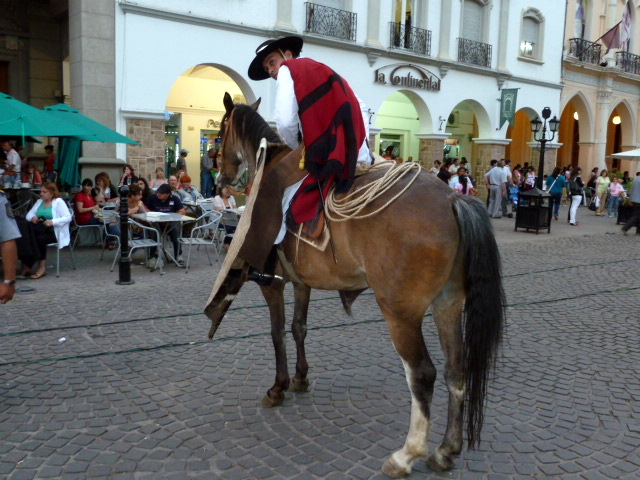
Gaucho from Northern Argentina in Plaza 9 de Julio square
As my hulking double-decked bus crossed the border from Chile into Argentina – the arid landscape changing gradually from taupe to green and the immense sky from bright blue to charcoal gray – my thoughts shifted from the sharp accidental elbow to the ribs I had just received from the Brazilian bruiser sitting next to me to the impending rain.

San Bernardo Convent, the oldest building in Salta, dates back to 16th Century
It was with mixed emotion that I welcomed the raindrops beginning to pelt the bus windshield. I had not seen rain since July. Not a drop. The Atacama Desert had certainly lived up to its reputation as the driest place on Earth. But now, I was across the border in another land, another time, another place, another weather pattern. And while I appreciated finally seeing rain, at once I also wished it away. I simply didn’t want it to ruin my plans for this highly anticipated long weekend. Let the raindrops fall some other time.
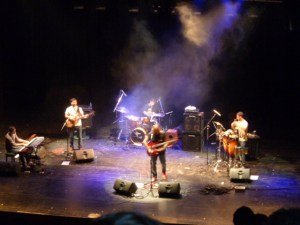
Argentine blues band Electrohope, performing in Salta. Great concert!
South America blows my mind. Let’s stay with the usually humdrum topic of weather for a moment. I had left the always sunny Atacama Desert to spend a few days in Salta, Argentina. I first heard about Salta from a friend in Calama, Chile, where I am wrapping up a six-month teaching gig. On more than one occasion, he said Salta was a beautiful place worth the 12-hour bus ride from Calama. The road to Salta from Calama winds through canyons, across high desert, and over mountain peaks so high, lungs themselves shift into overdrive.
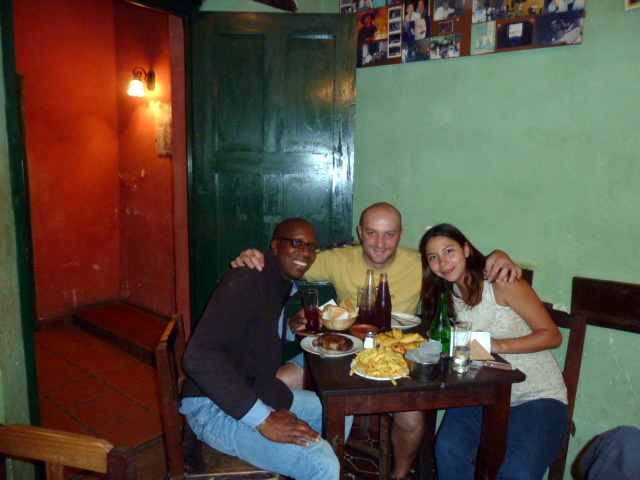
With my CouchSurfing hosts Lucas and Emi at La Casona del Molino restaurant.
Many travelers unaccustomed to altitudes reaching close to 20,000 feet above sea level, have trouble breathing accompanied with headaches. These are the first signs of altitude sickness, which in a worst case scenario can kill you. Getting to lower altitude as quickly as possible usually takes care of the problem. Drinking coca tea also helps. As a preventive step, your friendly neighborhood pharmacist can also help in the way of medication.
Needless to say, getting to Salta is no Sunday stroll. Some of the roads cut through canyons so narrow and overlook embankments so steep that from the upper level of a double-decked bus it can stimulate a quickened heart and sweaty palms. I admit I’ve had such a fear of going over the edge, but seldom and only when it was warranted: the bus driver takes a curve so fast and so close to the edge of a steep cliff, it seemed that indeed we were about to go over the edge. 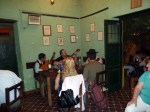 That happened once in Ecuador, where sections of the PanAmerican Highway cuts through some of the highest and most treacherous mountain passes I’ve ever seen. But alas, back to the weather. 🙂
Along the way, the driest place on Earth – that would be the Atacama Desert – was left far behind and progressively replaced with tiny green shrubs I watched llama feed on. Then the brown desert soil stared to vanish under swaths of green grass and canopies of a variety of trees in full bloom.

A night with friends making vegetarian empanadas
The closer we got to Salta, the greener the landscape grew. Then, as a reminder that all this green doesn’t happen without rain, rain clouds stealthily moved in from the east, creating shadows over the mountains. The menacing clouds released their liquid stuff on the valley where dozens of unburdened wild donkeys grazed and high above tall pines two falcons danced with the wind.  Patches of blue skies returned, but only to give way to fog so thick, it concealed the natural beauty I knew was all around me. The skies remained gray for two of the four days I spent in Salta. On my way back to Calama, about an hour outside of San Pedro de Atacama, the crazy weather got crazier. In the middle of summer, in the middle of the desert, on the high plains, a snow blizzard! I just could not believe my eyes. Snow? In summer? In the desert? In the driest place on Earth? Mother Nature having a bit of fun, eh?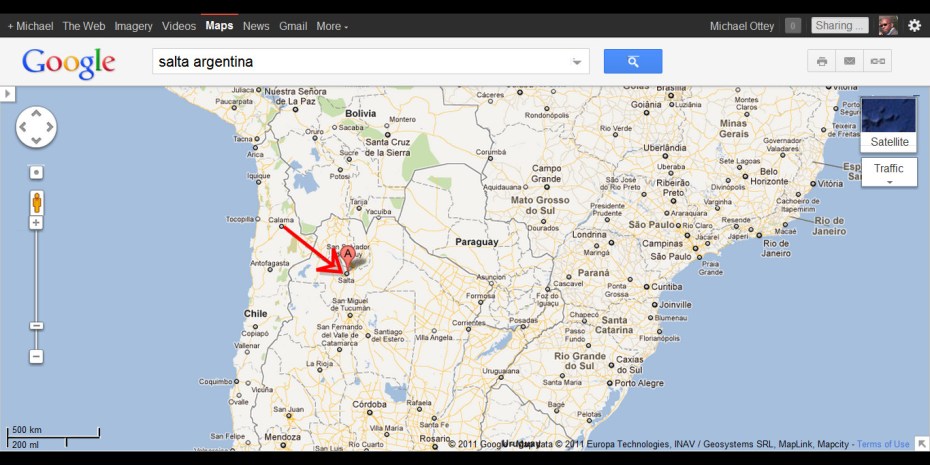
With the falling snow, a nearby volcano belching vapors, and high winds, the bus was forced to slow to a painful crawl. I say painful because 10 hours on a bus with two more hours to go, I was simply dying to be on terra firma.I don’t mind bus travel. It’s the guy who elbows me without so much as an apology that I mind.

Traditional dance on Balcarce street
It’s the guy with a nasty cold who sneezes at will without covering up. Spray your germs, why don’t you? It’s inconsiderate people who think communal space is theirs and theirs alone. They make travel more challenging. You roll with the punches, however. What else can you do?
This was going to be a great weekend. I felt it in my bones. I had heard much about Salta being a beautiful city with plenty going for it. I was ready to see for myself.
Getting transportation to Salta from Calama was a breeze. At least three bus companies – Geminis, Pullman and AndesMar – offer bus service via San Pedro de Atacama. I chose Pullman because AndesMar’s website was not accessible for days – I have no idea why – and Geminis had a string of complaints about its fleet of buses. I had a total of six days for this trip – two for travel to and from Salta. Pullman travels from Calama (and San Pedro) on Wednesdays and returns to both places on Sundays. It’s fleet of buses are not the best I’ve experienced in South America, but it’s fairly comfortable and the nearly $100 round trip cost does include snacks. Two movies in English with Spanish subtitles are shown during the 12-hour journey.

The bus left the Calama bus terminal about a half hour late but made up the time on the road. Processing through customs in Chile and Argentina was a breeze. I had gone through customs in Chile before (traveling from Peru and after to Bolivia) but customs in Argentina was a new experience. Salta would also be the first place I visited in Argentina. And after experiencing the place, it won’t be my last.
Immediately after arriving at the bus terminal, I was whisked to a blues concert. I landed there with my couchsurfing host Lucas. Dropped off my backpack with security and off we went. It was fantastic! Next day was spent walking around the city.
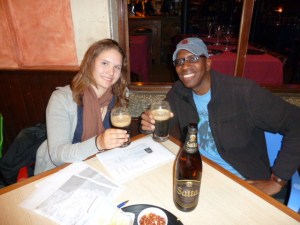
In Balcarce area with Meike of Hamburg, Germany
I immediately loved the place. Salta has a mix of modern and colonial architecture with some of the coolest bars and restaurants. The main party zone is on Balcarce street. If you don’t like crowds – think New Orleans at Mardi Gras – don’t come down to Balcarce. It is quite the wild party scene.
There are, of course, quieter venues to be found. Plaza 9 de Julio is the hub in the center of town. The square is lined with dozens of restaurants and shops that cater to tourists and for that, a bit pricey side. Try places just outside of the center, such as La Casona, where locals – as well as well-informed visitors – flock. The ambiance – a huge house converted into a restaurant, with an outdoor patio area – is relaxed.
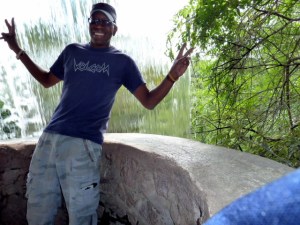
At the top of Cerro San Bernardo
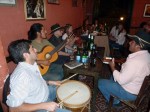
Locals bring their musical instruments for impromptu jam sessions – mostly folkloric music. And the food is excellent. I had a nice piece of steak – this is meat-loving Argentina after all – but you won’t have trouble finding vegetarian fare.
On my second day in town, I ate meat, chicken and cheese empanadas – a traditional food in this region – but on my third night my host Lucas and girlfriend Emi took me to a hostel owned by a friend, where every Friday night they cook up batches of homemade vegetarian empanadas. They were amazingly good! And of course, the company was great. Spent that evening eating lots of empanadas and washing them down with a $6 bottle of Malbec – Los Morros – I had purchased earlier that week in a fantastic hideaway in the center called Casa Moderna. Casa Moderna has old-country charm and feels family-owned. By the way, just up the street, back at the main square, the colonial cathedral – painted pink – is worth a visit. It’s filled with history and the gold altar is beautiful.

Only 1,070 of these steps to get to the top of Cerro San Bernardo
Salta and the surrounding area offer many activities, including horseback riding, canoeing, hiking and other outdoor pursuits. But you shouldn’t leave Salta without going to the top of the hill – closer to a mountain – by cable car or walking up. Some people choose to go up by cable car – about a 10-minute ride up – and walk back down. I walked up and walked down – twice! You get a panoramic view of the city at the top, and it’s a very relaxing environment, almost park-like. Those in need of adventure can rent a mountain bike at the top and ride down. The downside, in my opinion, is it’s a guided tour down. I wanted to come down the trail alone, but that’s not the kind of business they operate. Also, they need at least two people to sign up to take the tour. Next time, I take a bike up and fly down! 🙂
Related articles
- Getting Ready For Argentina (miketendstotravel.com)
- Last night in Salta – Salta, Argentina (travelpod.com)
- A Place In The Desert Sun Where Snow Kisses Sand (miketendstotravel.com)
- The Biggest Hole in the Ground? – Calama, Chile (travelpod.com)
- Salta – Salta, Argentina (travelpod.com)





 Mike Tends To Travel
Blah blah blah (Comments)