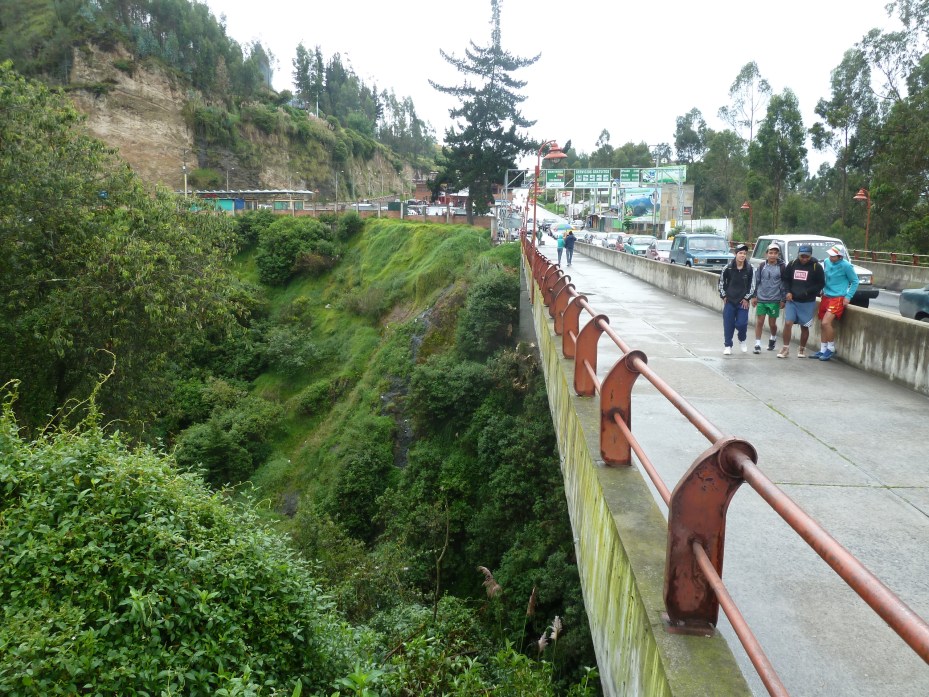
Friends In Strange Places

One of the joys of longterm travel is that you meet so many interesting people along the way. Traveling alone you make friends instantly, and consequently you almost never are alone.

Some of those instant friends become really good friends and you genuinely miss them after you move on to the next stop. Others are there for the moment, never to be seen or heard from again. To me, both the ones that become good friends and the ones that are like that puff of smoke, add value to the journey. For what is this journey if it isn’t about people?

Take Julio Catorce, for instance. I chuckled when he told me his name. Julio 14. Catorce in Spanish is 14.

Julio Catorce is from Guadaloupe. I met him at the entrance to the Equator monument near Quito, Ecuador. Julio Catorce approached me as I made for the exit. In perfect Spanish he asked if I was from Ecuador. No, I said. But your Spanish is so good, he said. Then from there our conversation evolved. Julio Catorce (by now, have you picked up I love saying his name?)  like so many I come across, asked me about President Obama. They all want to know about Obama, how he’s doing, what I think about him, will he be reelected, why Americans seem to dislike him, and how much the rest of the world loves him. For what it’s worth, whenever I traveled outside the United States during the Bush administration, all I got was an earful about how dumb we were as Americans to elect such a man. When you travel outside the U.S., sometimes the people you come across forget that you are not the government, and you can and sometimes do disagree with its policies. But you are perhaps the one chance they get to vent about America. So you politely listen and try to offer some perspective.
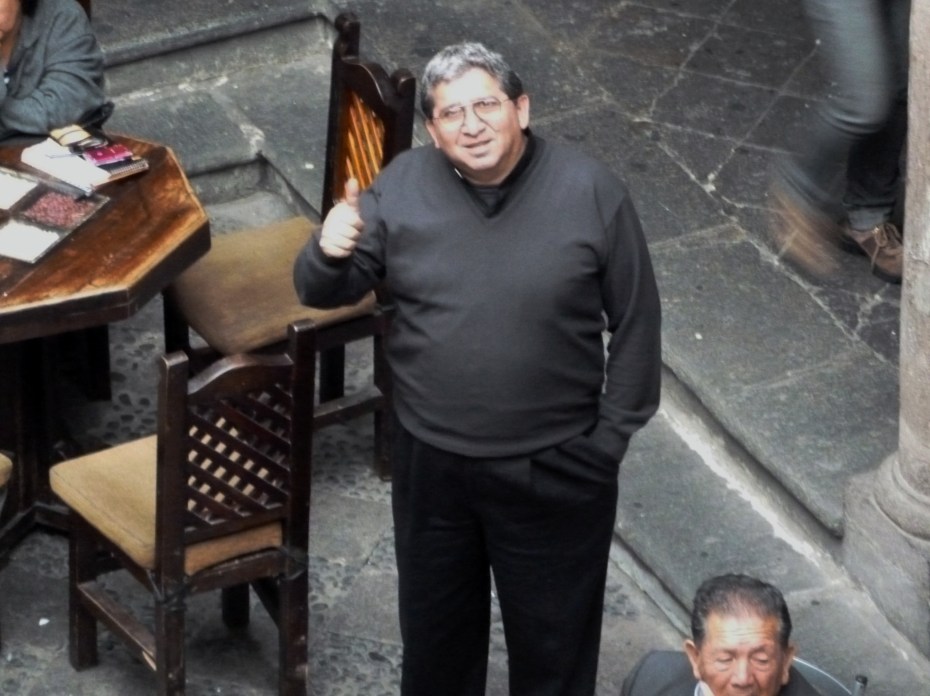
Thumbs up from Padre Miguel, who explained the Old Town

Julio Catorce said he wanted really badly to see Obama reelected. Why, I asked. What was at stake for him? Julio, who is of African descent, said everything was at stake, including the pride that black people around the world feel. He said they danced in the streets of Guadaloupe – a French territory in the Caribbean – when Obama was elected. And of course there were similar celebrations around the world. You would think Obama had been elected president of the world, Julio said. He then added, well, he sort of was given decisions made in the United States do impact just about everything in the world.

So enough about U.S. politics, I said to Julio Catorce. I wanted to know what was a young man – about 30 years old – from Guadaloupe doing in Ecuador. How does it even happen that someone from the tiny French island of mostly black people end up in Ecuador. Julio said he had left Guadaloupe in search of work. He and his wife decided to try Ecuador because getting into the country illegally was fairly easy and any job they got would pay in U.S. dollars. Ecuador, I remind you, adopted the U.S. dollar as its official currency more than a decade ago in the face of economic crisis and its extremely weakened currency, the sucre. The result has been that thousands have emigrated from their country to Ecuador, including  thousands of Colombians just next door, to get their hands on the mighty dollar. A dollar in hand is a great deal of money, compared to the time it takes to make that amount paid in pesos. The anti-America government of Ecuador President Rafael Correa is said to be studying ditching the dollar and returning to the sucre, a huge mistake say many in Ecuador who at first opposed the switch. Correa, who has decided to pick a fight with the United States by giving the U.S. ambassador “10 minutes to leave the country”, is not a very popular figure, but he knows how to keep poor and uneducated people on his side, borrowing a page from Venezuela President Hugo Chavez’ playbook. But that’s politics.
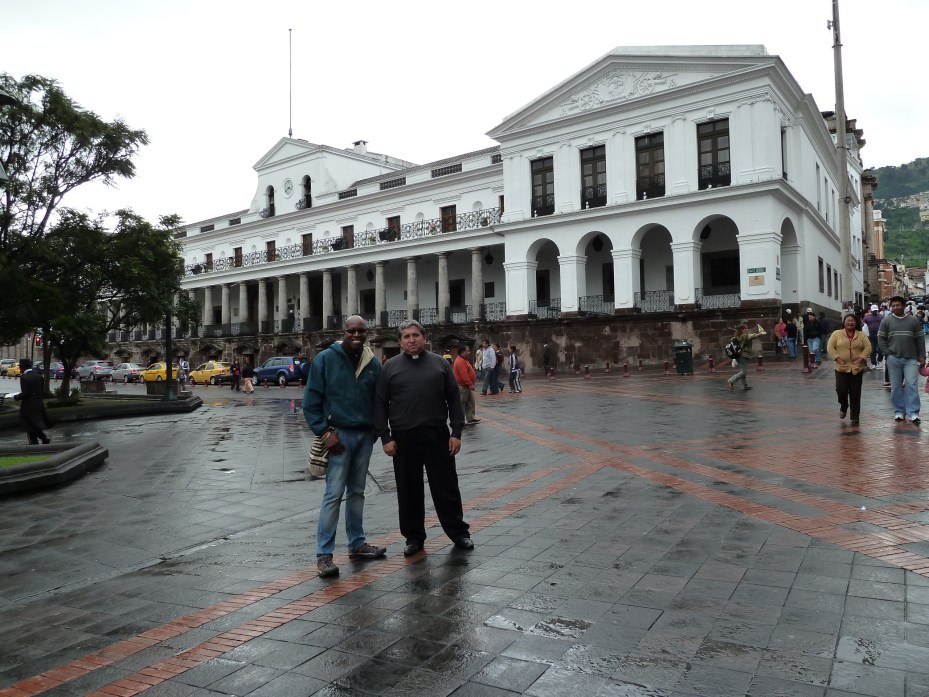
With El Padre in Plaza de la Independencia, Quito, Ecuador. He was born in the colonial town and used to play in this square as a kid

Julio Catorce said he hadn’t had much luck finding work, especially being illegal in the country, so for now his job handing out fliers for a restaurant at the Equator monument had to do. I asked the obvious question: If you are from Guadaloupe, a French territory and you are considered a subject of France, why didn’t you make for France instead? Not that simple, he said. Citizens of Guadaloupe don’t have the same rights to France as say Puerto Ricans have to the United States. Puerto Ricans are at birth U.S. citizens and have every right to travel to the United States and live there if they so desire. (By the way, why is it  so many Puerto Ricans stay put in Puerto Rico knowing they can live in the U.S. anytime they like? I’ve often wondered why Puerto Ricans choose to stay in Puerto Rico while people in other countries are lining up, paying crazy visa fees they’ll never see again, to live in the U.S. Somebody with better knowledge of Puerto Rico answer that one for me 🙂

So Julio, who speaks French and Spanish, is in limbo in Ecuador, and has been in that state for a good five years, he said. He would love to live in the United States, he said. Money is an object. More dollars in his hands, perhaps his own business, increase his chances, he says. Seeking the American Dream via Ecuador.

Julio talked and talked and laughed and laughed as staffers from the Equator monument shifted closer to listen. Julio Catorce – oh by the way, did I say that was not his real name, just something he made up because he liked the sound of it? – then tried to get me to go eat lunch at the restaurant he was pushing to visitors arriving at the monument. Too late. I had already grabbed food at another restaurant. But if I returned to the monument I would definitely go to the restaurant to make sure he got his commission, I told him.
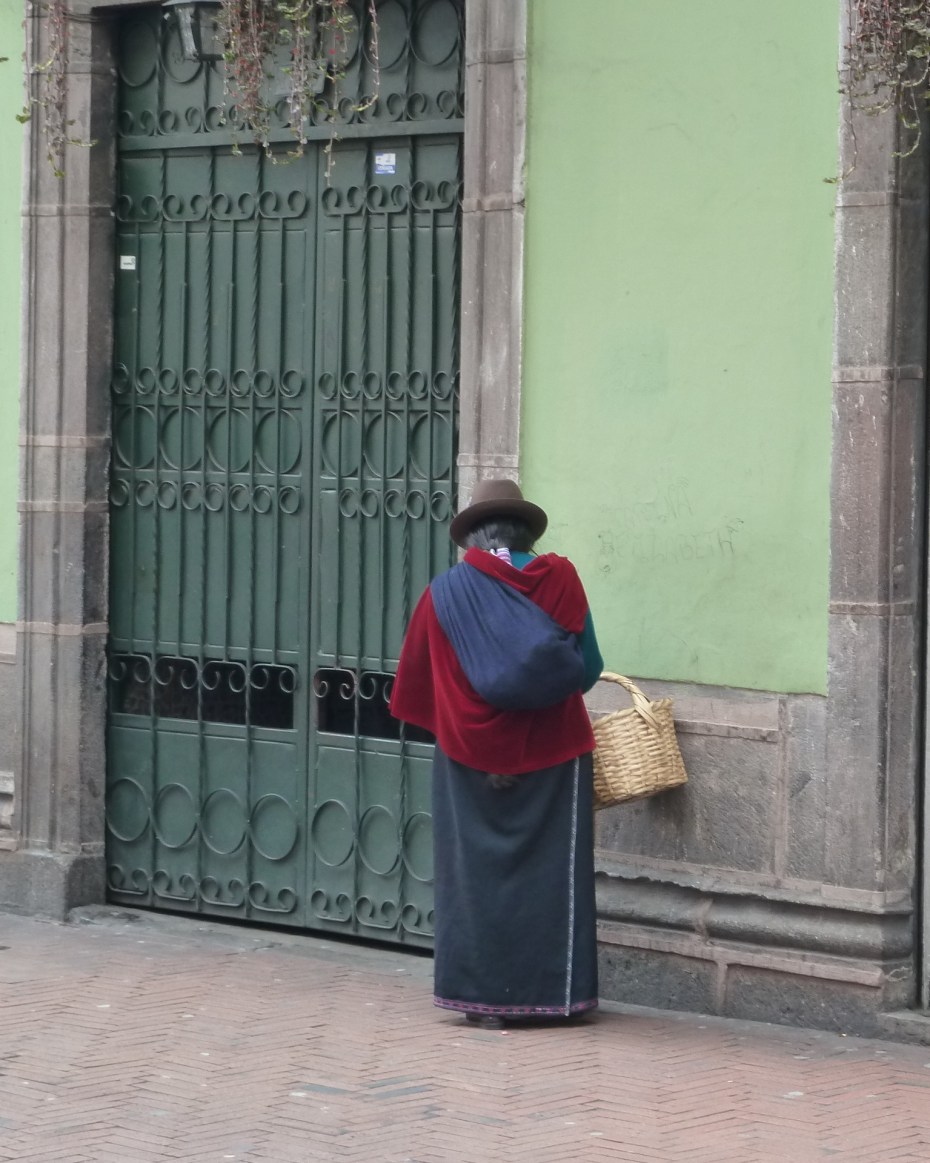
We talked apples and oranges - literally - then she turned and walked away

I never snapped a picture of Julio Catorce – or Julio 14, as he spells it. I thought of it only after I had long walked away. He became that puff of smoke, one of countless people I’ve already met on this journey. One of countless I’ve met in strange places. But I don’t think I will ever forget him. For that brief moment, he made me laugh. He made me think. He made the solitude of the journey disappear. While I’m alone on this trip, I’m never lonely. I’m always surrounded it seems by people like Julio Catorce who fill the gap between people who open their homes to me as hosts and allow me  dine with them and stay awhile. Those, more often than not, become longtime friends. They are among the people I will see again on this trip. People like Abdou of Paris, who is originally from Morocco, and promises a trip there when we meet again in Paris. We will travel to Morocco to visit his friends and family. He promises he will introduce me to some very cool places unknown to tourists. And certainly I will meet more people, the ones that come and are gone like ships, and the ones that will stick around, even if by Facebook or e-mail to ask “how are you?”  I’m sure I will have a blast with Abdou in Casablanca, because when he stayed at my place in Miami, through couchsurfing hosting Web site, we had a blast. When I drove him and his girlfriend Anja of Switzerland to the airport, I almost shed a tear. They were just such cool people. And I hope to see them again in Europe. Just as I hope to see so many others, such as Adam of London in Bangkok, where he now lives. And Anette of Finland perhaps in Amsterdam, because she doesn’t stay put 🙂 . And Dmitry in Russia. And Martin and Lucia in Slovakia, if they ever quit traveling. And one day return to Quito, Ecuador, to again say hello to Padre Miguel, who emerged from his church in the colonial area of Quito, asked where was I from, and volunteered to give me a walking tour of the Old Town. So many people, some puffs of smoke, but still ingrained in my memory, so many others everlasting friends.

And when I least expect it, sometimes in the strangest of places – such as on the cable car in Medellin, Colombia, where I met Lafonsa of Birmingham, Alabama, U.S.A. – I will meet others around the world that make this journey so worthwhile.

Categories: Rants and Raves | Leave a comment

The Equator: Let Me Lay It On The Line

I have a list of people, places and things I must see around the world before I die. I didn’t come up with this list overnight or because of some book I read. This list has been kicking around in my head for as long as I can remember. It’s the list that pops into my constantly shifting brain when I find myself daydreaming.  Among some of these places, the Egyptian pyramids. The Taj Mahal. The Great Barrier Reef. Singapore. The Arctic Circle. The Amazon. Brazil. Buenos Aires. The Serengeti. Stonehenge. On and on.

I have traveled to every continent of the world, except Australia and Antarctica – and have already checked off from my list many places and things to do, such as climbing the Great Wall of China or pretending to prop  up the Leaning Tower of Pisa. Yesterday, however, had I not done my research, I would have left Ecuador thinking that I had stood in the middle of the world – on the imaginary line known as the Equator – the middle of the world.

One of  my lifetime goals was to visit the Equator and stand simultaneously in the northern and southern hemispheres – right on the Equatorial line that divides the planet into the two hemispheres. But in this world, things aren’t always so simple.

Straddling north and south? I think not 🙂

When in 1743 scientists set out to establish the line that divides the Earth into the northern and southern hemispheres, they came pretty close, but they were off by almost 1,000 feet, 20th Century scientists using modern-day technology discovered. Using G.P.S. and other mapping tools, they learned that the middle of the Earth was actually several feet north of where it was originally designated by the 18th Century scientists. So the Equatorial line shifted (does anybody remember reading this important bit of news?), rendering markers and grand monuments marking the spot off base, including the permanent and elaborate Mitad del Mundo – Middle of The World Monument in San Antonio de Pinchincha, located about an hour and two bus rides from the center of  Quito, Ecuador’s capital. Still today, thousands of people visit the monument and snap pictures with their feet straddling the orange line painted from the base of the monument through the plaza. Little do most of them realize they are not actually standing in the two hemispheres, just in the Southern Hemisphere. To stand in the two hemispheres in Ecuador, you must exit the Middle of The World village built around the monument to cater to tourists and take a five minute walk  north along a dirt road. There you will see perched on a hill the Intiñan Museum. The museum, which features tribal artifacts and replicas and information about local tribes, some that have no contact with the modern world, has been around since the 1960s. Its original focus was largely local flora and fauna and preservation of the country’s fragile ecosystem. But the museum struck gold when it was determined that the actual Equatorial line runs through its property. So, of course, museum officials rushed to capitalize on that fact ($$$$) and added Equator exhibits, experiments, and a tour. They also painted their own line on the ground that marks the Equator. They charge an admission fee of $3 for the pleasure.

The actual Equator, hundreds of feet away from where scientists had originally established

Yet, despite the change, not many visitors know that the Equator is now more than 900 feet away from where X – the Middle of The World Monument – marks the original spot. So they come, snap pictures and leave thinking they stood on the Equator. How sad when they get home and learn they’ve traveled thousands of miles and didn’t experience the real thing.

Now, it is completely accurate to refer to the spot where the monument stands as the “historic” or “old” Equator, as Ecuador tourism officials do, but they do it ever so hushed. They’ve invested millions of dollars building the monument and town around it – with restaurants and gift shops, and imagine what that would do to yearly visits and the bottom line if people decided to go to private Intiñan Museum instead of the government-run monument and complex? That frankly will never happen because the monument and village that doubles as a tourist center are still worthwhile. The grounds are simply beautiful.

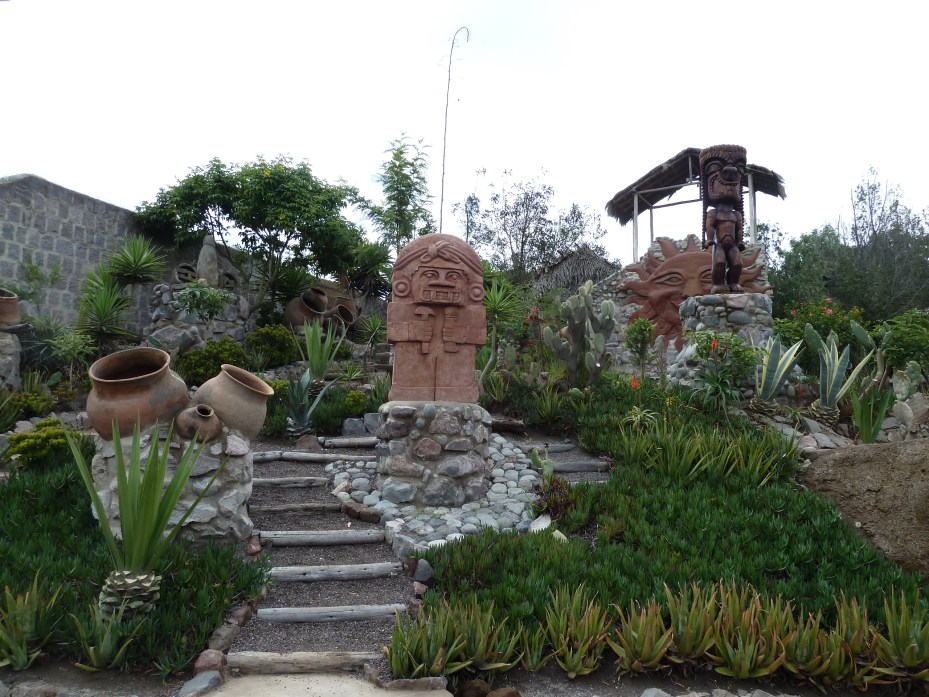
Up there: The museum where the Equatorial line actually runs through.

I asked a tour guide at Intiñan how the museum coexists with the nearby better-known Middle Of The World Monument and  the other museums and businesses that depend on tourists for their survival. She said it’s a peaceful coexistence and that the Middle of The World Monument still has its place, given it commemorates the daunting achievement of the 18th Century scientists from France, Spain and Ecuador who braved the Amazon and tough conditions to find the planet’s middle.

By the way, to confuse visitors even more, there are several other places in Ecuador where you can supposedly stand on the Equatorial line. One them is in a town called Calacalí.

The Middle Of The World Monument: No longer on the Equator, but still a nice place to visit

Calacalí, where indigenous people centuries ago had somehow established they had found the middle of the Earth, brags that the Equator runs through the town. To honor the ancients, in 1979 a smaller monument  that stood since the 1930s to mark the Equator, was moved west to Calacalí. The current, much larger replacement was built between 1979 and 1982. But in Calacalí, the original monument is also not where it should be. The Equator through that town is actually closer to the town square. So if you go to Calacalí looking to take pictures at that monument know that you are not at the Equator, you will have to go a few steps further.

Meanwhile,  Intiñan is modest compared to the grand, beautifully laid-out Middle Of The World Monument compound in Pichincha. But Intiñan is well-worth the $3 admission. And you will then be able to say you actually, really, truly stood in the middle of the world, like I did. 🙂

Middle Of The World tourist center. Shops, restaurants, musical performances

Categories: posts, Rants and Raves | Tags: , , , , , , , , , , , , | 2 Comments

Cali To Quito: The Earth Moved

Oh, the rush of sitting in a bus stuck on a dark mountain road, being pelted by a torrent of rain, when suddenly part of the mountain comes crashing down, mud sliding beneath the idle bus, rocks and boulders bouncing around you like beach balls. The sound alone of the mountainside sliding down in the darkness is enough to make start wondering what will you do to escape being pushed over the edge of the cliff by the force of the moving earth or being buried alive. I and some 30 others was a sitting duck on this road trip to the border town of Ipiales, Colombia, and the mountain was shooting at us. When it rains this heavily, walls do tumble and fall. I’ve seen the aftermath of mudslides and hillsides giving away. In Colombia, the land is scarred with such after effects. I just never imagined I’d ever witness such a horrific force of nature, let alone be standing in its path. Before family and friends get to worrying, we escaped harm, with a truck ahead of us taking the brunt of of nature’s beating. But what a night it was.

I left Cali, Colombia, Friday evening. I was excited to see Quito, Ecuador, my destination on this leg of my journey. I’ve been to the Northern Hemisphere. I’ve been in the Southern Hemisphere. How cool would it be to stand at the Equator, the exact middle of Earth?

The bus left late – nothing unusual there – and it began to rain when we left Cali. Nothing unusual there, either. It is rainy season in Colombia, and it has been raining quite a bit. Before I arrived in February, I saw news reports of floods, of houses being washed away or falling off hillsides because of landslides. It seemed no part of the country was immune from the torrential rains. Not even the Tatacoa Desert near Neiva, which was unusually green in some parts because it got heavy amounts of rain.

So I came to Colombia during the rainy season, but I knew on this journey I would hit bad weather somewhere.

The road from Popayan to Pasto twists as it climbs and snakes even more at higher elevations between Pasto and Ipiales. I’m not sure which stretch of road we were on when we hit stalled traffic, but I overheard the bus driver tell an inquisitive passenger that this stretch of road scares him. He then shared a story about boulders the size of buses have rolled off the mountain and that landslides were fairly common. He didn’t have to remind anybody of that; road signs did that, but there was evidence of earlier rock falls.

I woke up when I felt the bus come to a complete stop. I was seated in the first row with a clear view out the large windshield. There was a truck in front of us, it’s orange warning lights flashing in the dark. Ahead of it, more vehicles, all standing still, their engines off. The only sound I heard was the rain pelting the bus and the thunder that followed lightning. It was eerie, so surreal, so scary for anyone out here alone.

The bus driver put a plastic shopping bag on his head, retried a flashlight and head out into the rain. He disappeared into the darkness as he headed up ahead to investigate what was the hold up. He returned, soaked, and told the passenger who asked that rocks, mostly small ones but a couple of large ones, were blocking the road. He said some truck drivers were trying to remove them. He added that there was no emergency work crews or police in these parts at this hour. It was shortly after 3 a.m. Luckily we still had communication, as the driver got on his cell phone to report the situation. And so we waited.

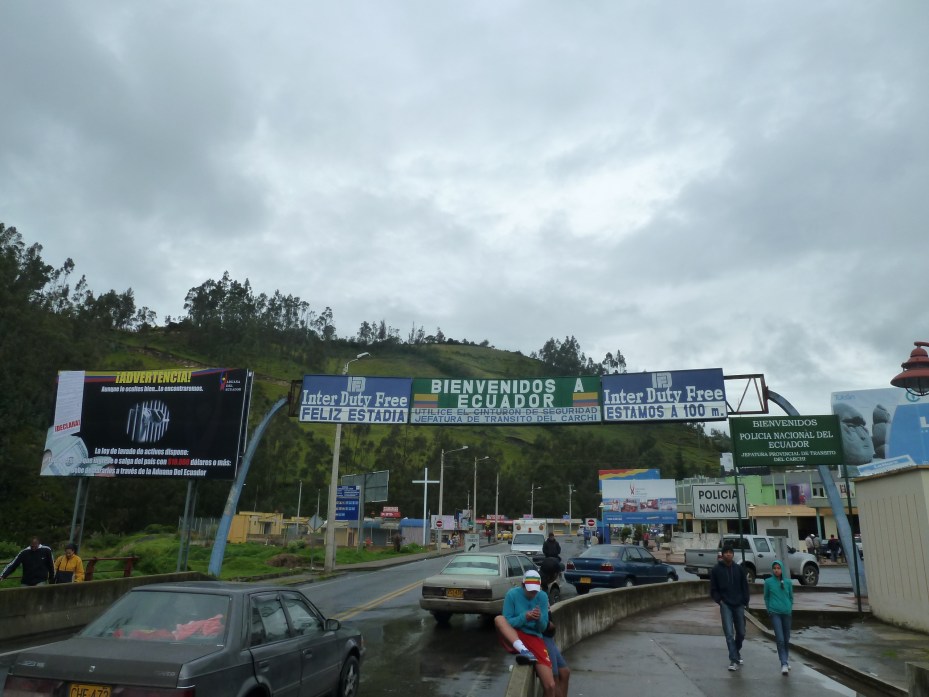
This bridge between Colombia and Ecuador is all it really takes to go from one country to the next. Hardly any border control, basically left to the traveler to stop and get proper passport stamps

Then came that sound. It was a sound of something cracking. And before anyone could react to ask what it was, we knew what it was. Watery mud slid under the bus. And rocks fell, bouncing off the road, some breaking into pieces, others rolling between us and the truck ahead. The bus driver turned on the engine and a woman on the bus seated behind me freaked out. Those who were sleeping through this pause in the trip, awoke wondering aloud what was happening. The driver said we had to get out of this zone. But we couldn’t move. Cars and trucks stranded in both directions. The driver started to honk the horn, as if to send a signal that it was no longer safe to wait. “Vamonos!” he let out. “Let’s go!”

Then, as if by some miracle, I saw the headlights of an oncoming truck. Traffic in the opposite direction began to flow. The truck drivers were successful in opening the road ahead, if only partially. When it was our turn to go, the bus had to squeeze by some pretty hefty boulders partially blocking the road, and drive over rocks. We spent a good 10 to 20 miles performing this maneuver, sometimes coming close to the edge of the road and the mountainside or cliff, to get around the fallen rocks. Didn’t get much sleep on the bus that night.

When we reached Ipiales, sleepless, tired passengers emerged. A man approached and tried to sell me breakfast as I got my backpack. I declined. I had survived the trip on water and Oreo (with double stuff, of course) cookies. I needed a bathroom. I needed a bath.

I made my way to the bathroom – 600 pesos a woman at the door demanded – and I splash water on my face and felt like crap. I needed more sleep. But I had to push on. From Ipiales, I would need to take a minivan – they call them colectivos – to Rumichaca, the Colombi-Ecuador border post. About a 10 minute drive. Once I cleared customs on both sides of the border, another colectivo to the center of Tulcan, a border town in Ecuador. From there, I’d have to find the next bus out to Quito. Simple, right?

On both sides of the border you are accosted by dozens of men holding stacks of dollars – the money exchangers – aggressively asking if you want to exchange your Colombian pesos for U.S. dollars. If you don’t already know this, in Ecuador the national currency is the U.S. dollar. Facing a serious currency and financial crisis, Ecuador dumped its currency more than 10 years ago – the sucre – and adopted the dollar as its official currency.

So these money exchangers literally surround you, and of course you need to exchange money. Supposedly, you get a better rate in Colombia than in Ecuador. Some merchants on the Ecuador side of the border- including the colectivos – will accept Colombian pesos, but their preference is for the U.S. dollar. Others say you can keep your pesos, thank you.

For those thinking about crossing the Colombia-Ecuador border, let me say this loudly and clearly: EVERY PERSON EXCHANGING MONEY ON THE BORDER IS OUT TO CHEAT YOU.  THERE IS NOT A SAINT AMONG THEM. That’s how they make their living. They don’t charge an exchange fee, so how else do you think they turn a profit?

These men are more often than not successful in taking your money, with some fast finger work on a calculator. They are like magicians. So here I go again with the caps: BRING YOUR OWN CALCULATOR TO THE BORDER AND USE IT! Your calculator will produce a more favorable return on your exchange than their calculator. Trust me on this.

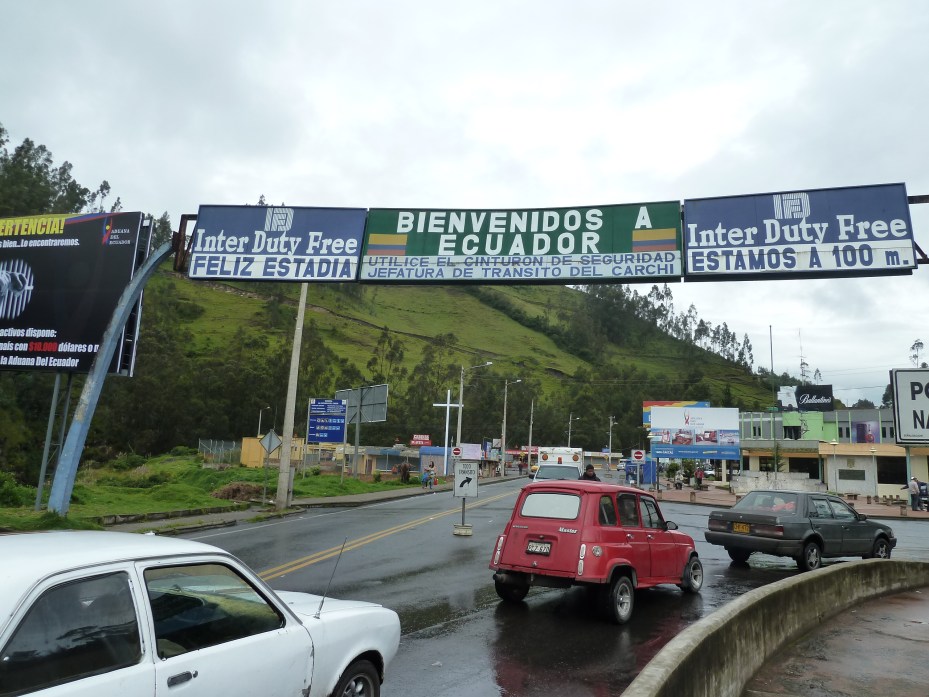
Leaving Colombia, a different world awaits on the other side

The guy I chose to convert my pesos into dollars pulled out his calculator and told me the rate he was offering. It was 1,990 pesos = 1 dollar – which to me sounded like a very good rate. So I said okay. But when he input the amount of money I wanted to exchange divided by the 1,990 rate, his calculator showed $325, the amount in dollars I would be getting for my pesos. Since I had read about these kinds of trickery at the border (thank you Google), waited until he did his computing before I produced my own calculator. I would beat him at his own game: He gives me what sounds like an excellent rate, does the math on his calculator, then shows it to me. If I were to show him I had a calculator before he started his shenanigans, he would likely offer a lower rate or maybe just walk away to steal from some other sucker.

So I reached into my pocket and pulled out my iPod Touch, which has a calculator. After I did the math on my calculator, the amount came out almost $100 higher. The man, as his two partners in crime talked nonsense as a diversion and distraction tactic – “hey, where you from?” “that’s a really cool shirt” “You’re gonna love Ecuador, you should check out…” – was clearly disappointed that I had a calculator and did my own math. He was busted. He gave me the higher amount I had come up with plus an extra dollar because I owed him a dollar in the exchange and I did not have change. So in the end, he ended up the loser – by a dollar – on the deal. No sweat, he said, and moved on to rip off someone else.

At the border I met some other foreign travelers and told them what happened. They had all exchanged money, too. Concerned, they asked me to do their exchange on my calculator. Every single one of them had been cheated out of anywhere from $10 to hundreds of dollars. What could they do? They were already on the Ecuador side of the border. You have to be smart about your money, and you might think a calculator doesn’t lie, well in the hands of crooks and thieves it does.

I made my way on foot across the bridge that spans the border between Colombia and Ecuador and went directly to customs. I got in line but it was not moving, and growing longer instead. The customs office doors were also locked, though there were customs agents inside. Soon word came that the computer system had crashed and they had been working for at least two hours to fix it. Then as hundreds of people waited patiently in line, a stampede toward a nearby copy center was set off by a customs agent who announced the system was still down and to move ahead with the processing we’d have to provide a copy of our passport. People dashed off to the copy center and started a line there. But patience waned when customs again created confusion by telling people inside the office only those who were seated would be attended, so everybody should take a seat and they would be called by row in the order they were seated. Some people at the end of the line managed to snag seats in front. Not fair, a woman screamed. Others openly protested, screaming at the customs agent who threatened to have then tossed back across the border.

After some more impatient pushing and shoving that erupted outside, misinformation by Ecuador customs agents, rushing about and forming other lines to make requested copies of my passport, I was officially allowed into Ecuador 5 hours later, a process that would normally take minutes.

One bright spot: on the van to the Tulcan bus station, where there are buses to Quito, a man who looked to be at least 80 years old and could barely walk without his cane, serenaded us on the bus with his guitar and a beautiful folk song. He had a raspy voice, and coughed a bit between the lyrics, but the music was soothing – a pleasant way to enter Ecuador after the customs debacle. By the way, when you’re hanging around a border crossing for any length of time you meet the most interesting people. I spent most of my time there with a trio of travelers – a guy from Bolivia, his French girlfriend and their Argentine friend. They were traveling across South America, broke – no money – and working odd jobs here and there to keep traveling. They joked they only had 80 cents among them and that would likely only get them to the next town. I gave them some Oreo cookies. They told me lots of funny stories about their travels. They were penniless, but happy.

Just a walk across the border

On the bus to Quito I tried to get some sleep but the bus made frequent local stops and at every stop vendors entered trying to sell everything from food to pirated movies, some more aggressive with their sales pitch than others. One woman placed a bag of marshmallows on my lap as I was seeking music on my iPod. She said I didn’t have to buy, that I could at least have a look.

And so went to journey from Cali to Quito. But I must say during daylight, the landscape to Quito is very scenic, with breathtaking mountains, deep canyons and rushing rapids. Then, a break through the clouds – the Andes!

Quito, you may be cold and wet and dreary and way up in the clouds, much like Bogota, but you are all panoramic splendor and natural wonder. And now I am at the center of the world, glad to be here and ready to explore.

Categories: posts | Tags: , , , , , , , , , , , , , , , , , , , | 3 Comments

Blog at WordPress.com.