travels

Pilgrimage To Ayquina

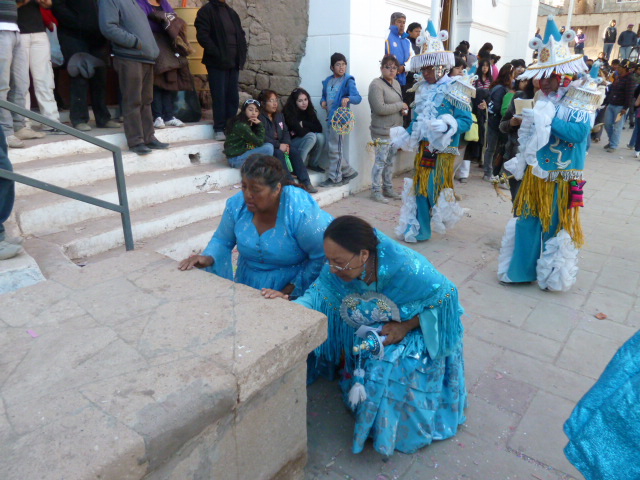
Aymara women stop for a quick prayer in the square just outside the church in Ayquina

I have to say that lately I have been too comfortable. I don’t like it. Comfort hardly ever amounts to motivation. A person gets comfortable and it makes them not want to get out and explore beyond that “comfort zone.” I get home from a long day of teaching English, weekend comes, and the part of me that wants to stay home wins out over the part that wants to get out and see the world. Too much of that and we’re in “stagnation zone.”

All week I had been talking about traveling to Ayquina to experience the annual religious-cultural pilgrimage that draws people by the thousands. People from Northern Chile, Southern Peru, Bolivia and Northern Argentina  – and tourists from every corner of the world – come to this dusty small town to pay tribute to the Virgen de Guadalupe de Ayquina, who according to legend appeared in the spot where the tiny church stands in her honor. Thousands walk across the desert from Calama to reach Ayquina.
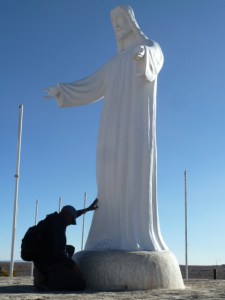
Me, at nearly 10,000 feet above sea level, giving thanks for safe travels

Chris and I arrived in Ayquina in the late afternoon by bus. We had made a last-minute decision to experience the annual religious-cultural pilgrimage in the desert town where about 50 mostly Aymara people live. Incredibly, the town swells to almost 75,000 people for this week in September. During the week, the faithful come to pay their respects to the religious icon known locally as “La Chinita.” I didn’t want to miss this event and so the voice that tells me to get out and discover doled out a bruising defeat to the one that promotes idleness.

I must say it felt good to be back on a bus headed to some unknown place. Chris and I joked that the bus company had pulled a fast one by displaying one of those new, double-decked buses with comfortable reclining seats and other modern conveniences, then at the time of departure revealing the actual bus we’d be traveling in. It was tucked way in the back, hidden from view: an old, rickety, smelly bus that had seen better days. Oh, it didn’t matter to me, really. During my travels across South America I had been on worst modes of transportation, some downright dangerous, if not cruel and unusual to man and beast aboard. I was just happy to be off on another adventure, even in a bus that looked like it could not make it down the street.

The Virgin Guadalupe of Ayquina

We arrived in Ayquina in the late afternoon and immediately launched into snapping photos. Chris – oh did I not introduce this Canadian character Chris? He’s from the sticks somewhere just outside of Toronto. He’s my newest housemate – with now five people in the house. He wears the Maple Leaf on his sleeve like some Americans wear the Stars and Stripes. I’ve never met a Canadian more patriotic. At every opportunity he talks up Canada – Canada’s tourism board ought to give him a medal – and takes good-natured swipes at the United States. We have this ongoing Canada versus U.S. banter that provides for some comic relief. But I swear the man has maple syrup running through his veins!

So Chris and I walked all around the town shooting pictures of the Aymara dancers dressed in their traditional dress. The Aymara remind me of the Incas. Their dances, their manner, their traditions are similar. The Incas did conquer this part of Chile, but their culture did not really take root because the Spaniards arrived soon after. Still, the Aymara – heavily concentrated in neighboring Bolivia – are close cousins of the Incas. In Cusco, I was fortunate to experience the traditions of the Incas. And now in Northern Chile, which was once part of Peru and Bolivia, I was now witnessing the traditions of the Aymara. It was simply spiritually uplifting.

This slideshow requires JavaScript.

Categories: posts, travels | Tags: , , , , , , , , , | Leave a comment

The Mighty Pacific Ocean Shakes, Rattles And Roars

The waves proved too much for this fishing boat anchored just offshore in Iquique.

After more than a month in the desert in Calama, I was really looking forward to some beach time in the more hopping seaside town of Iquique. Mother Nature, however, wasn’t having it. Nope.

I woke up and pulled back the curtains of my hotel window and saw massive waves rolling in and pounding the beach. It was an impressive sight. They were waves that reminded me of the ones I had seen on my visits to Hawaii. I tried to open the windows but they are sealed shut. I jumped in the shower, got dressed and headed to the beach, a block away.

Swimming was banned. Boating activity curtailed. A surfing competition postponed.

Iquique is home to extreme water sports, but the extreme weather kept aficionados on land. Many of them, young and tanned men and women, just sat on the shore and gazed at the ocean, looking bored.

Surfers who jumped at the chance to “hang ten” were under strict orders to use jet skies to get out to the waves. Paddling out was an exercise in futility and dangerous, one lifeguard told me. Lifeguards were on duty to warn surfers – the only ones daring enough to venture in – to be cautious. Flooding was reported in several cities along the coast, including minor street flooding in Iquique. Residents flocked to the beach with cameras to record the huge waves. And for most of the day, the sky remained gray, though there wasn’t a drop of rain.

I spent the day walking on the beach, then headed inland to the center of town. Walked the length of Baquedano Boulevard, a pedestrian-only street lined with colorful colonial houses now occupied by businesses that include restaurants, gift shops, language schools, museums and tour agencies. Then I headed to the port, where fishing boats were firmly anchored. The rough seas were expected to last through Sunday, although the lifeguards said they had noticed a gradual calming. Good. I just might get my beach time in after all.

This slideshow requires JavaScript.

Categories: posts, travels | Tags: , , , , , , , , , , | Leave a comment

Weekend in Iquique

Tonight I go on a road trip with Chileans. We are driving to Iquique, a port city on the Pacific coast founded in the 16th Century. It is a city beloved by Chileans. They say it has the nicest beaches and the best nightlife of any city in the country. The people there, I’m also told, have a very happy disposition. The good weather has something to do with that.

Iquique, located west of the Atacama Desert, draws scores of visitors also because of its duty free zone, one of the largest in South America, almost one square mile of warehouse shopping. It also boasts great restaurants, bars and the aforementioned nightlife.

But Iquique is also a beach town. Surfer dudes abound. Quite a bit of activity in this city of more than 200,000 people, which was once part of Peru until Chile took it away in the late 1800s during the Pacific War that saw Bolivia and Peru allied against Chile. Chile proved militarily superior and took land and cities that belonged to both. For Peruvians especially, the war was an indignity because Iquique was home to many of their national heroes. Now, the city is firmly and unquestionably Chilean, even if Peruvians to this day still lament the loss.

Other than what I have been told, I’m not sure what I will find in Iquique. In my travels, I’ve been pleasantly surprised by places I didn’t think I would like and disappointed by others for which I had high expectations. I have a good feeling about Iquique. We’ll see.

No matter what, I will be spending my time there with Chilean friends I’ve made during my month in the country, and so that alone should make it enjoyable. Two of them actually live in Iquique. So seeing the city with them will be fantastic.

Pictures of hopefully a fantastic four-day weekend in Iquique – Monday is a national holiday – to come.


Categories: posts, travels | Tags: , , , , , , , | Leave a comment

Blog at WordPress.com.