
Two hours into a 22-hour bus ride from Lima to Cuzco. The movie selection? Something with George Clooney and a woman falling for him. The bus? Half empty, so why then can’t I change my seat to escape the incessant yapping of guy who just got his first cell phone? The sun? First time I’ve seen it since arriving in Lima. Lima is grey in winter. But I’m no longer in Lima. I’m somewhere south where there is sun. In fact it’s desert-like with the ocean on one side. On the IPod? Brazilian music. Always feels like carnival, samba. All is well – except for phone chatter over here. Cuzco will be a huge highlight. Cuzco, Peru. Machu Picchu. Pinch me. Go ahead and pinch me. You have my permission.
Rants and Raves
Twenty-two Hours On A Bus
Categories: Rants and Raves
Tags: Cusco, Cuzco, George Clooney, Lima, Machu Picchu, Mobile phone, Music of Brazil, Peru
Leave a comment
In Peru, For Good Luck, Pinch A Black Person
I don’t remember how the subject even came up – I believe one of the U.S. Peace Corps volunteers I was having lunch with in Piura, Peru, asked if I had been pinched yet by total strangers since my arrival in Peru. She said in Peru, there is a superstition among some Peruvians that if they pinch a black person it will bring good luck to the person doing the pinching. Seriously?
Apparently, several African American Peace Corps volunteers based in Peru routinely experience this assault on their person in Peru. It may be something black or mixed race Peruvians are accustomed to or simply tolerate, but for blacks from the United States it’s not a welcome gesture, nor is it a compliment, as some of my own white friends recently suggested when I asked their opinion on this practice.
I generally try to keep an open mind when it comes to the customs of other societies. That doesn’t mean that I embrace them all. There are some things that are just downright wrong – or illegal – and I cannot morally support. This pinch a black person for good luck thing I immediately found offensive – then I took a step back to think about it – and after much thought, I am still of the mind that it’s offensive – not a compliment – an assault and deeply rooted in racism. An how did I reach this conclusion? I know my history.
Some people don’t want to hear it, but the fact is black people have a history of being treated as property – as a thing to be had rather than human – nothing more than a tool to be used. In addition to being enslaved to provide others with free labor, we as a people were subjected to a whole slew of indignities – we were “boys” and “girls” no matter our adult status. We were treated as less than, not to be respected. And as my dear friend Darlene pointed out in a Facebook discussion as to whether or not randomly walking up to a black person you don’t even know and pinching them for good luck is offensive or a compliment, there was a time when in the United States rubbing a black person’s head was said to bring good luck to a white person. Thank goodness such racist nonsense has faded away with slavery in the United States. But now I am in Peru. And in 2011, I can’t even sit quietly on a street corner without someone stepping up to pinch away.
A day after my Peace Corps pals told me of this pinch a black person for good luck thing, it was far out of my mind as I sat on a curb watching the world go by in the center of town. I had just done a lot of walking and was drinking a just-purchased bottled water. It was an extremely hot day in Piura despite the fact it was officially winter. My mind was on my trip south to Lima and a bunch of other things I had to do to make the 15-hour journey happen. Then without word or warning it happened. A woman walked past me, pinched me on my upper arm, and kept going without stopping. My reaction scared the crap out of her and I am now glad it did. Next time she’ll think twice before she goes around pinching a complete stranger if only for their skin color. I asked her why she did what she did and got a nervous smile, nothing more. I raised my voice to be heard over the hustle and bustle of the area, as the gap between us grew. I yelled how would she like it if I walked up to her and pinched her. How would she like it if total strangers kept doing that to her for the rest of her life. She quickened her pace. I stood up and started walking in her direction. How would you like it if your children were pinched by random people on the street? She turned the corner and vanished, but not before she took one last glance at me. The smile was gone. Good.
Now, some of you might think I overreacted. Think what you may. If you believe I should put up with strangers pinching me all day, for weeks, for months, for years, for the rest of my life, I’d like to lend you my shoes. Walk in them and talk to me as you lay dying. Tell me how much you enjoyed the experience and that life of being treated with such blatant disrespect.
Peru, is a beautiful country with a great history. I am by no means picking on Peru. Racism exists in other places, in my own United States. I’m sure I will come across other practices – other superstitions – that are just as offensive to me, if not more. But this experience is here and now, front and center. It’s one that took me by surprise. And I, for one, am not going to allow this assault on my person anywhere. Nobody should.
Categories: Rants and Raves
Tags: Alberto Fujimori, BBC, Demographics of Peru, Facebook, Lima, Ollanta Humala, Peace, Peru, Piura, South America, United States
Leave a comment
Izhcayluma: The Inca Gods Must Be Crying

Izhcayluma, now known as Vilcabamba, was a playground for Inca royalty
Waiting sometimes gives us a great deal of time to think. But we as a species hate waiting. Impatience takes over and crankiness takes hold. In extreme situations anger builds and it’s unleashed.
On a long journey you have to learn to keep cool. Patience. Use the wait time in productive ways.
Ten minute wait for a taxi, the hotel manager said. Immediately I wondered how I could productively spend those 10 minutes. Ah, I need the exact address of the hostel in Vilcabamba where I was headed. A couple of days earlier in Cuenca I had seen a hotel brochure. The brochure to the Izhcayluma Hosteria contained not only the address but a map with specific directions. It won’t take more than 10 minutes to walk over to the Cigale Hostel and Restaurant where they had a bunch of the brochures on a table. I told the Victoria Hotel manager I’d be right back and headed over to the Cigale. Good thing I did.
My original plan to get to Vilcabamba from Cuenca was to take a taxi from the Victoria Hotel to the airport ($2.50). From the Cuenca airport, just across the street, I would then take a minivan that carries up to 15 passengers to Loja ($12). Then from Loja, hop on another bus for a 45-minute ride to Vilcabamba ($3). It would have taken my 7 hours to get to Vilcabamba at a total cost of $17.50.

The 150-year-old Vilcabamba Church in the town square.
But as I reached for an Izhcayluma brochure at the Cigale, I noticed posted on the wall a flier for a minivan shuttle service from the Cigale directly to the Izhcayluma. For $15 and in only four hours I would be delivered directly to my hotel in Vilcabamba! No need to taxi to the airport in Cuenca. No Need to change buses. My trip from Cuenca to Vilcabamba shortened by 3 hours! Obviously a better deal.
The waiter at the Cigale handed me the restaurant phone to make the reservation. Done. I rushed back over to the Victoria to announce my change of plans to the front desk. When I got there he had already placed my backpack in a waiting taxi. I approached the taxi, gave him .50 cents for his wait and told him I no longer needed his services. Off to the Cigale I went to wait for the shuttle to Vilcabamba. Departure time, 1:45 p.m. It was 12 noon. More waiting. I fired up the laptop.
In no time the driver of the van and his assistant entered the Cigale. They asked if I was going to Vilcabamba. They said we’d be ready to go shortly since I was the only passenger. Really? An entire van all to myself? What luxury!
Keep in mind that travel in South America and many other developing parts of the world are often cramped, smelly, dirty and uncomfortable. This was a major score. In three months of traveling across the continent I had never had the pleasure of having transportation all to myself. This was heaven.
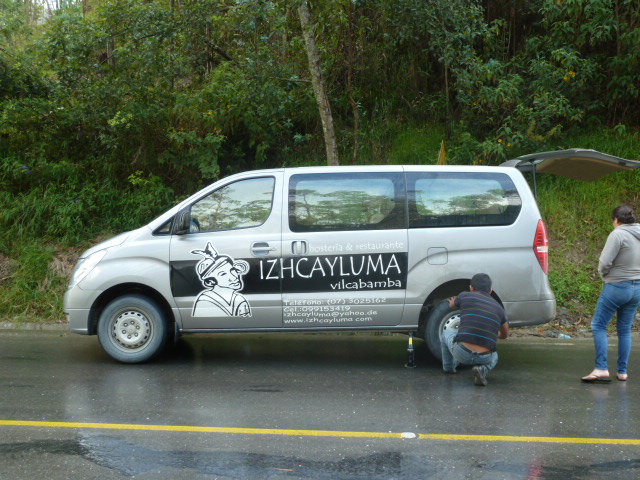
Tire goes flat during trip from Cuenca to Vilcabamba.
And heaven it was. The journey to Vilcabamba was a real pleasure. I spent it chatting with the couple – the driver and his assistant. They told me stories about Vilcabamba. How “the gringos” had taken over the town. How the village was a mecca for all sorts of kooks, including a man who swears the world will end in 2012 and convinced a visiting friend to help him build an arc. The man maintains that the entire world except Vilcabamba will be destroyed. Why Vilcabamba? They did not know. But that’s the reason he came to the village. I really want to meet this man and see his arc, which I’m told is complete. He is currently stocking it with food and plans to start adding animals – two of every kind, of course – as the end of the world grows closer. I really want to meet this guy! Then again, maybe not. I’ve already met my share of natural healers, tarot card readers, hug circles, self-described Messiahs, hippies, potheads, lunatics, dropouts, and yes, retired gringos who make up more than three-quarters of Vilcabamba’s population. Needless to say, English is spoken here in abundance.
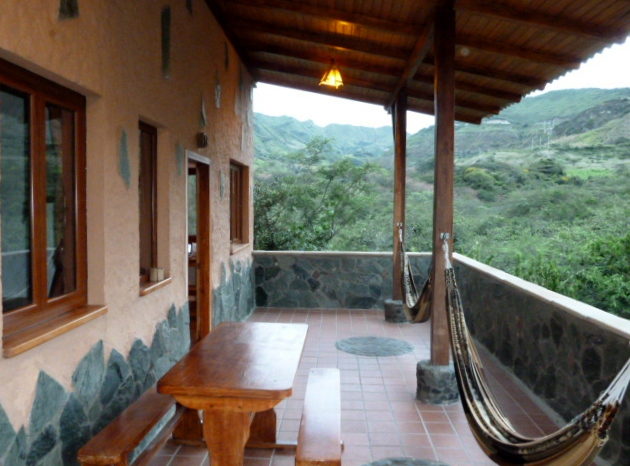
My private cabana space overlooks the mountains. The town is below, deep in a valley
Ecuadorians in Vilcabamba have grudgingly embraced the gringos. They include among “los gringos” Europeans, mostly Germans. But all foreigners to them are gringos. The gringos came to town and took over. They began to buy up property. A steal in their minds, but to Vilcabambans, they paid way too much. That drove up land and home prices. And drove out the locals. Soon, restaurants, shops and grocery stores that catered to the specific needs of the gringos began to crop up. Canned foods on shelves. Processed foods. Signs in restaurants and around town in English. Businesses geared toward tourism and touring. The entire make of the town rapidly changed. And the gringos are still coming. A huge development just for the gringos – no way locals can afford such home prices – is being built just outside of Vilcabamba. It’s Little U.S.A. in Ecuador. And the town that is known worldwide as a place where people lived well beyond 100 years of age is losing that. Their longevity was largely credited to their simple lifestyle, the natural foods they ate and the purity of the local water they drank. They’ve now started to eat and drink what the gringos eat and drink and it is taking its toll. Someday, Vilcabamba will no longer be able to claim its place in the world as the valley of longevity.
Unlike some other road trips, I arrived in Vilcabamba without any incident to report. We had a flat tire outside the town, I helped the driver change the tire and in 25 minutes we were on our way.
I settled in to my rustic cabin and marveled at the landscape. Izhcayluma – the name the Incas gave the place before it became Vilcabamba with the arrival of the Spaniards – you are breathtaking. No wonder so many outsiders have come here. And yet I can’t help but wonder if the Inca Gods are in tears over what this ancient and majestic land has now become.
Categories: posts, Rants and Raves
Tags: Cuenca Ecuador, Ecuador, Gringo, Hotel, Hotel manager, Inca, Inca civilization, Loja Province, Patience, Recreation, South America, Taxicab, travel, Vilcabamba, Vilcabamba Peru, Waiting staff
3 Comments


 Mike Tends To Travel
Blah blah blah (Comments)