posts

Montañita

Jugglers, musicians, all sorts of street performers all over town. You will be entertained.

On a visit a few years ago to Santorini, Greece, I sat at a sidewalk café contemplating – yet again – the meaning of life.

As I sipped a very strong cup of coffee on this beautiful island, its crystal blue Mediterranean waters shimmering in the early morning sunshine,  I basked in the idea of someday dropping out of society and making my home in a small village such as this one on Santorini. The idea was made even more appealing given the fact this tiny village was on an island not easily accessed by the average traveler.

Yes, Santorini gets its minions of visitors, but the vast majority arrive on cruise ships, spend money but little time. To otherwise reach isle, you must fly to Athens and hop on a ferry, too much of a trek for some. Most people with limited vacation time –Americans – simply opt for other more accessible parts of Europe, thank goodness! For this island is so tranquil, especially on the other side away from the ships – it’s the perfect place to escape to read, write, watch the world go by and even contemplate the meaning of life.

African dance on the Ecuadorian beach in the glow of sunset

So I said to myself, this is where I will come to drop out of the hustle and bustle of everyday life. I will simply show up one day on the island, not tell a soul of my destination, and never leave.  To the villagers, I will simply come to be known as the oddball American who turned up one day and just spends his days at the beaches, cafe, walking about town, but mostly reading, writing who knows what, and relaxing. Santorini. Yep. That would someday be my exit. That was it. That is, until a few days ago I discovered another option: Montañita, Ecuador.

Counterclockwise, Katu, Eeva, Kahyda, Yemmy, Victor Hugo and the headbanded me! 🙂

I first heard of Montañita during my two-month journey across Colombia. I was in Taganga, a fishing village in northern Colombia overrun with “gringos” – most of them American and Euro potheads and pseudo-hippies. One of my companions mentioned that Taganga had some similarities to Montañita, largely in the carefree people it attracted. At first, I had no interest in visiting Montañita. Seen one hippie commune, seen them all.

But once I made it to Ecuador, I began to hear more about the place. And once I arrived in Guayaquil, my host Veronica and mom Sara in Ecuador had sold me on the place. I decided I would go. Then behold the power of the universe: an e-mail arrived in my inbox. It was from my Ecuadorian friend Kahyda, whom I met in Barranquilla, Colombia, and who was among those that first told me about magical Montañita. In her e-mail Kahyda said she and others had hired a driver with a van for a weekend trip to Montañita and it would be great if I came along. Oh, yeah!  A few days later, six of us in the chauffeured van were off to the legendary beach town to have fun on its beaches, in its bars and clubs and streets teeming with street performers.

I had heard stories about Montañita, but didn’t know exactly quite what to expect. When we arrived, a smile that pretty much never left my face took over. I was very pleased.

First,  Montañita is off the charts as far as laid-back, stress-free  beach towns go.  It was a three-day weekend in Ecuador, so it was jammed with people, a nice mix of Ecuadorians and foreigners. The foreigners were mostly surfers, hippies, partiers, misfits and dropouts. The don’t worry, be happy, live and let live crowd. My kind of people 🙂 . Totally chilled. They set the mood and the tone of the town.

Second, the town was built for them, by man and nature, with its gazillion cheap hostels, lots of beaches with big waves for surfing, lots of sunshine and hot weather, plenty of places to eat, drink, party and have a good time.

On weekends, the incredibly loud music throughout  Montañita is on full blast for 23 hours a day! Choose your hotel wisely. Choose a hotel or hostel next to a dance club and you better be prepared to stay up all night. The sound system from the dance clubs shake and rattle everything, and that may include you!

Sunset swim

I didn’t choose my hotel. I point the finger at Kahyda 🙂 To sleep, I stuck my earphones in my ears and cranked up my iPod. My music was preferable to the BOOM BOOM BOOM bass from the dance club next door that shook the bed and bounced off the walls.

On weekdays, Montañita tones down the partying a bit for a more very relaxed atmosphere, some might say even boring. The loud music, mostly Salsa and Reggaeton, that is piped across the town is gone. By Thursday it’s back and by Friday it is cranked up again and never really stops. Invest in earplugs.

But this is a place where you come for a good time or to escape something – or someone. There are a thousand stories here. People who left something or someone for this spot on the Ecuadorian coastline. This oasis. There are many places in the world where you can party all day and all night long. But Montañita is part party scene, part hippie commune, part surfer town, part circus, part sexual escapade, all rolled into one, nicely coexisting. I loved the place and found it hard to leave. So did the owner of Hotel Montañita, where I stayed. David, who is from Chicago, said he came to visit the town years ago and never left. He bought the hotel and the rest is history.

Someday I’ll be David, living in a town like Montañita, no rush, no fuss, hanging loose. But for now, I am off to perhaps discover other Santorinis and Montañitas.
Categories: posts | Tags: , , , , , , , | Leave a comment

Riding, Slipping And Sliding Down An Andean Volcano

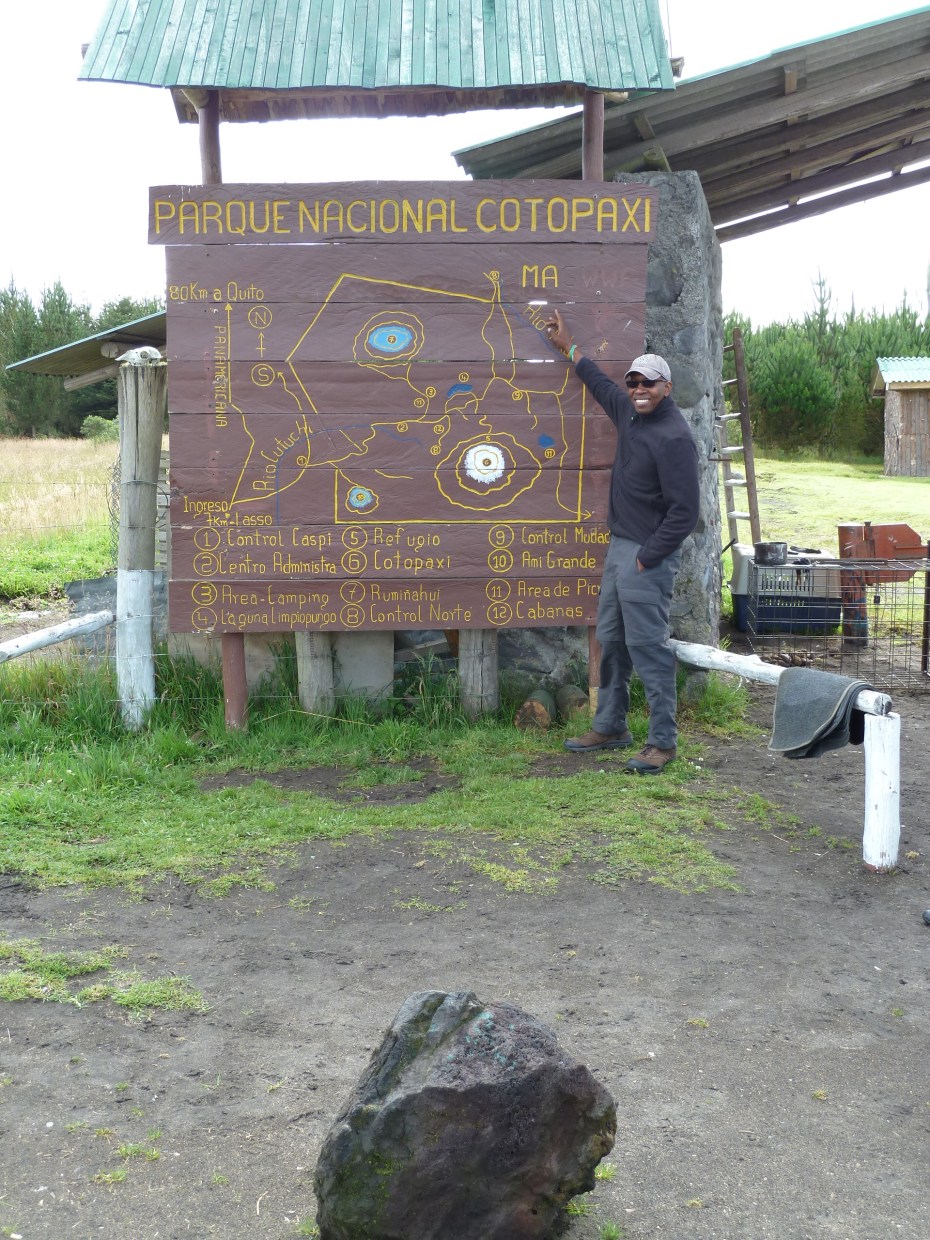
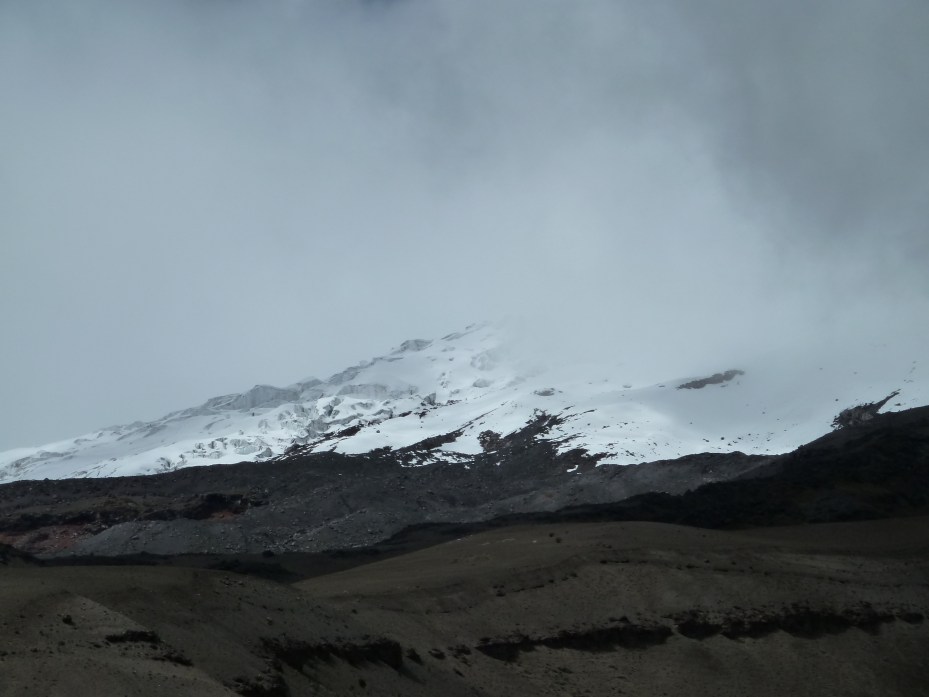
The very chilled Cotopaxi volcano

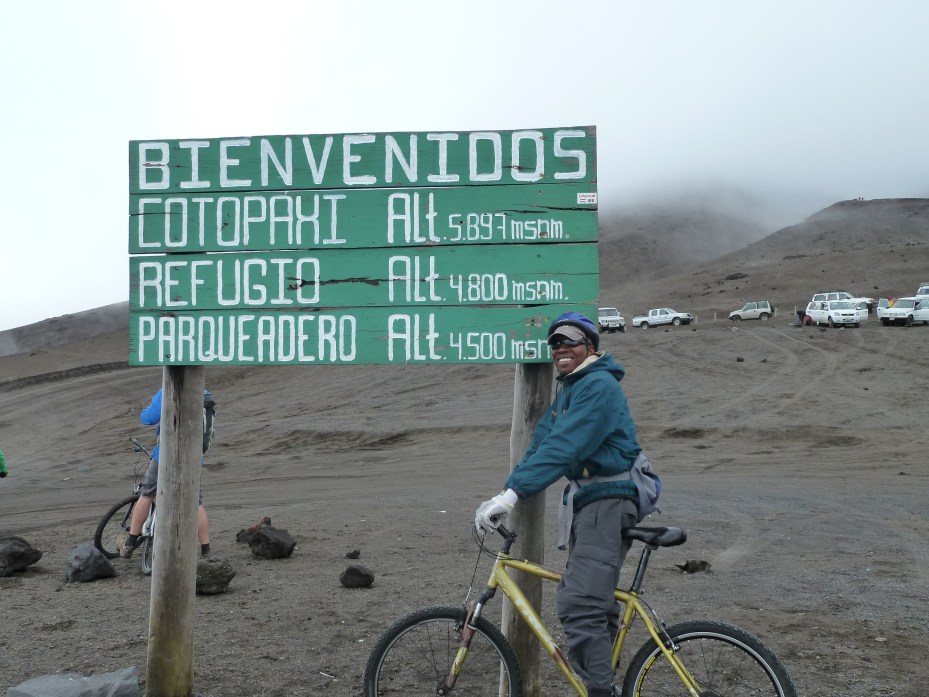
I took one last glance at the peak of the 19,347-foot snowcapped volcano, wrapped my gloved hands around the handlebar of the gold Trek mountain bicycle, placed both feet on the pedals, and flying down the peak’s jagged slopes I went, taking the first curve extremely fast, the rear wheel sliding to the right and then to the left as I pumped the brakes to slow down. Not a smooth start to this bike ride down Cotopaxi, Ecuador’s highest active volcano and second highest peak.

Thats me, coming round the mountain

I managed to stop the bike without falling. It wasn’t a pretty stop, but it was stop. There at that curve that came so suddenly and so soon, I listened to Diego, our guide on this bike tour of this beautiful and yet potentially deadly mountain that has logged more than 50 eruptions over centuries. Quito, Ecuador‘s capital, could face a major disaster if Cotopaxi were to explode. Similarly, other towns in the valley near the volcano could be wiped out by mudflows. Cotopaxi, scientists predict, will one day blow its top to disastrous consequences. But none of the people who see the volcano every day ever really think about that. What they think of is its beauty, it’s place among peaks in the Andes mountain range, and they appreciate Cotopaxi for what it is – a natural wonder.

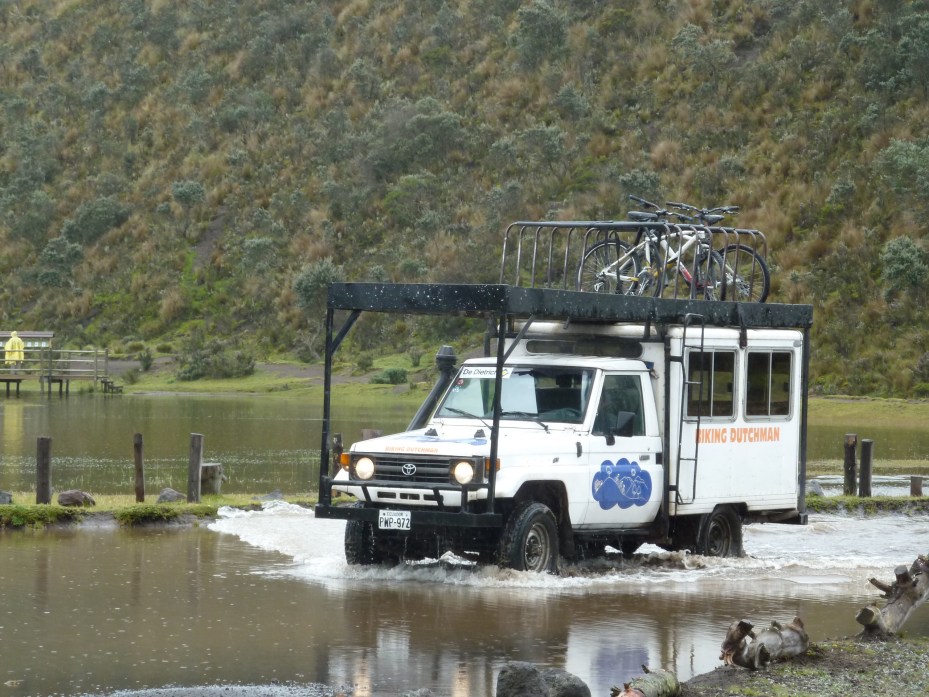
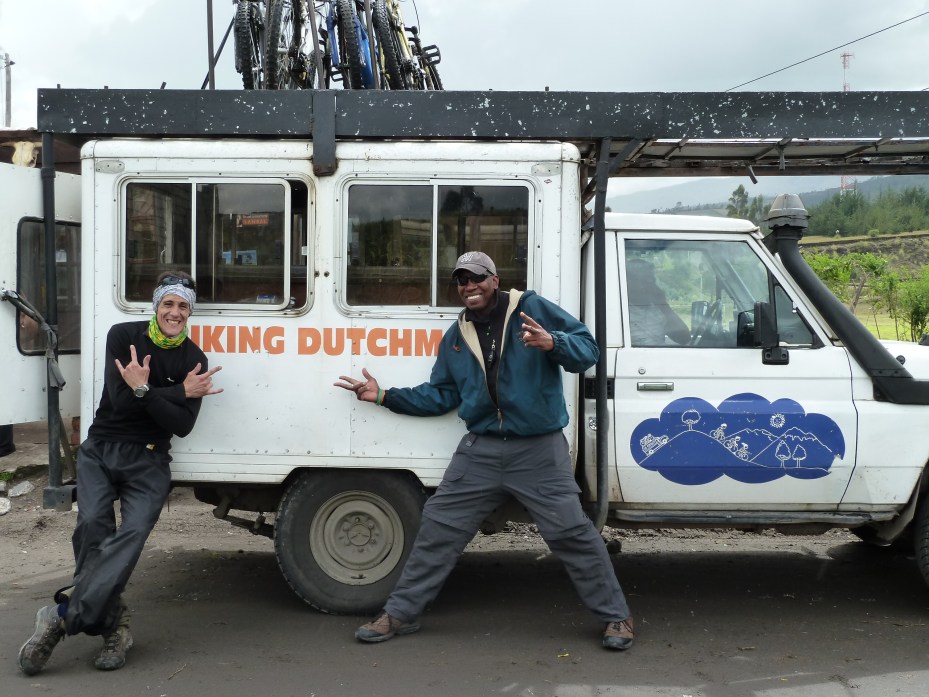
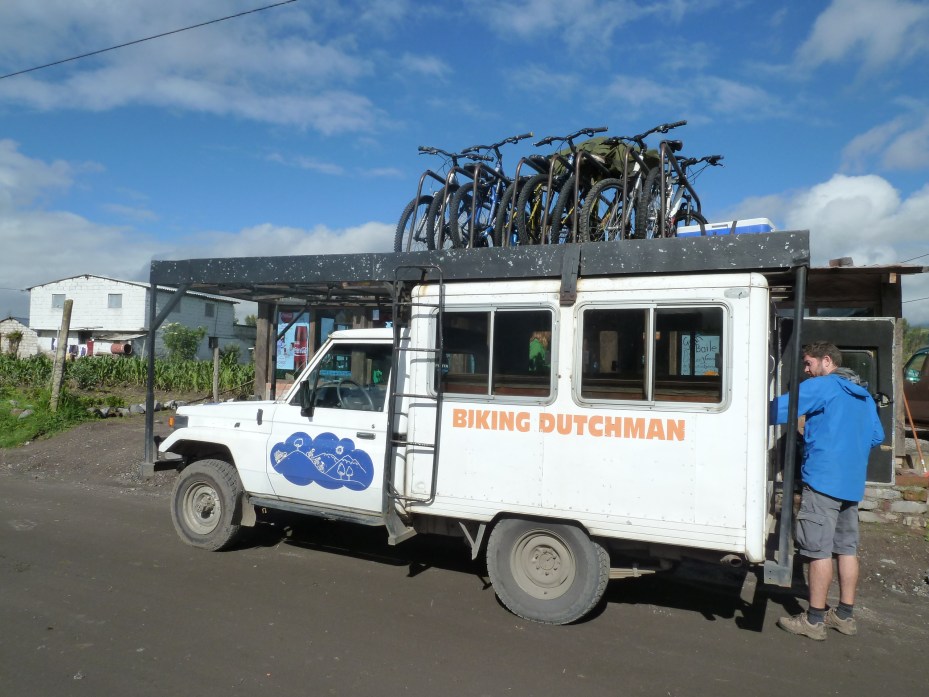
Diego, a tall and lanky Ecuadorian, leads these bike tours of Cotopaxi and other peaks in the Andes several times a week. He works for a tour company named The Biking Dutchman. The company’s owner is dutch.

The Bike Beast - Crossing the waters of a swollen mountain lake

I don’t know where Diego gets the strength to ride these peaks as a job. It’s not exactly office work. It’s extremely physical and even dangerous: rain-soaked and bumpy dirt roads and uneven paths covered with volcanic ash, loose gravel, protruding rocks, rain-filled potholes, cars, trucks and wild horses – yes, wild horses – on the road, and those sharp curves, all make for a great challenge. Miscalculate and you just might wipe out – or be wiped out. But what is adventure with no risks?

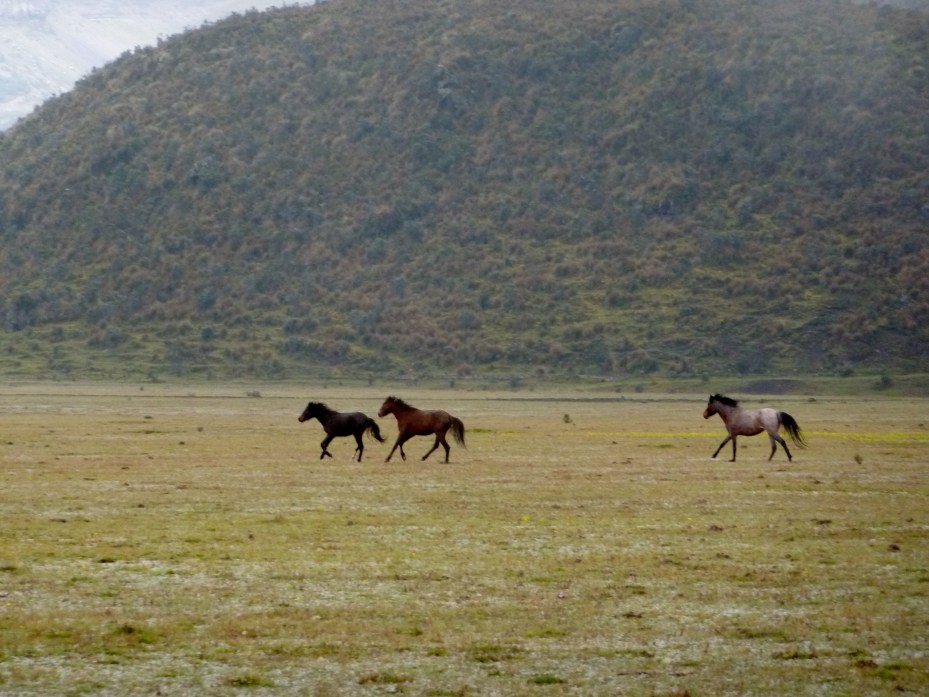
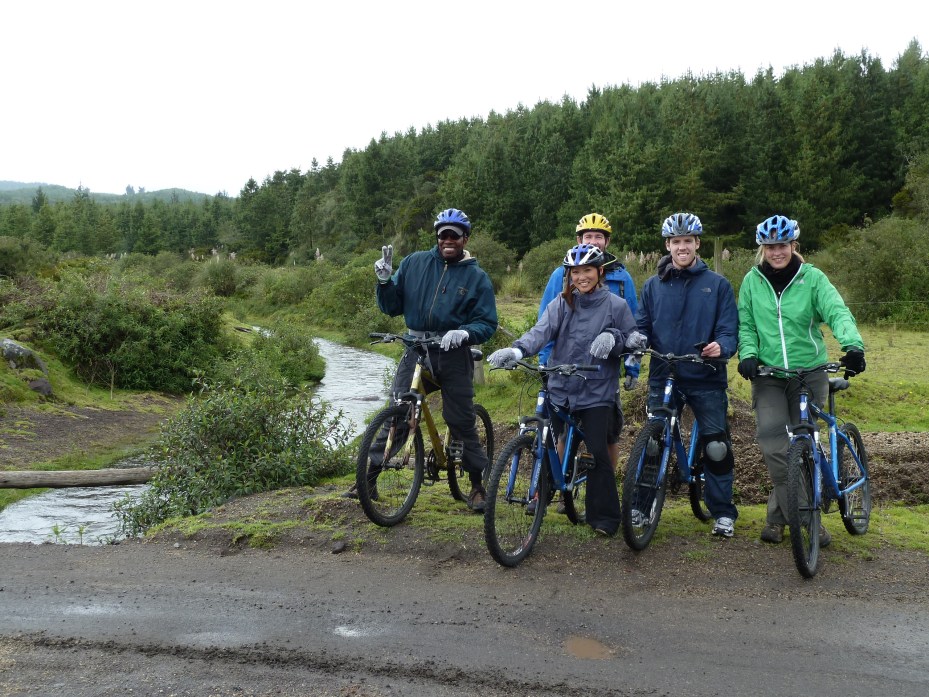
At that first hard curve Diego stopped to point out the terrain, below the peak, a valley formed millions of years ago by Cotopaxi’s eruptions. He said maybe we would be able to see the wild horses that roam the valley. Spanish conquistadors brought horses here and these wild horses are of that lineage of horses left behind by the Spaniards. Indeed we saw several of those horses further down the mountain, trotting across the roadway, as we sped on our bikes toward them. On this trek, not counting Diego and a driver, there were five of us: a couple from Canada and another couple from Scotland that now lives in London. We were all going to test our mettle on this trip down the mountain, which involved some challenging climbs, especially given the thin mountain air.

Wild horses run across the valley at the foot of Cotopaxi

We started this tour at 7 a.m., meeting up at the Magic Bean hostel and cafe. After I loaded up on coffee and a cream cheese bagel, we hopped in the Biking Dutchman four-wheeler that would take us more than 14,000 feet up the mountain. From there, we would ride down, mostly down a steep and curvy road, but as I earlier said, there were a few uphill battles which some of us – myself included – lost: we walked our bikes. On one of these walks up the climb, here goes Diego pedaling along: “Hey Michael! This is the last one, it’s all down from here, come on, join me!” Yeah, superman. I’m right with you. 🙂

We made it!

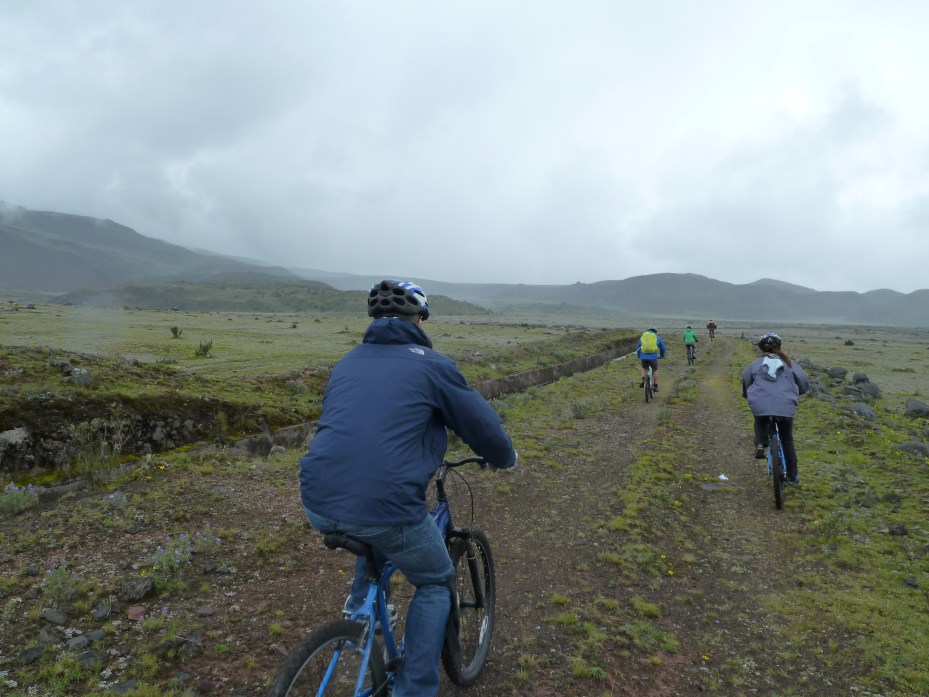
On the way down, I was going so fast it was as if I was flying. At this point it was raining and my face was being pelted by the rain, dirt and gravel that somehow mysteriously was airborne. Churned up by cars and riders ahead of me, perhaps?

After a few minutes on the bike I had shed any fear and relish the speed down the volcano. I had done plenty of road cycling, but not much mountain biking, so there was somewhat of a learning curve (hahaaha, no pun intended 🙂 I figured out when to grip the handlebar tighter and when to loosen my grip; when to raise my butt off the seat and stand on the pedals; when to brake and when to simply just let go. I must have hit speeds of up to 40 mph (conservative estimate) going down the mountain’s slopes and even on some of the curves, feeling the bike slip and slide, but always trying to stay in control. That’s key, maintaining control even if you are going fast. Also extremely crucial, losing all fear. If you are afraid, you will get hurt. If you are too cautious, you will have no fun, and then what was the point of going up the mountain? You may as well have stayed in the city, sipping a mocha.

This kid was too funny!

So down and round and down and round I go, fast, all I hear is the buzz of the wind at my ears, wet, cold and warm all at once. I unzip my jacket to cool off then I’m too cold. Zip it back up, one hand on the handlebar – steady! The rain has clouded and the cold have clouded my Oakleys – my sporty sunglasses – which I then question why am I even wearing them, there’s no sun. I continue on, flying down the mountain, then come to a canal. I stop to take a photo. Here comes Diego: “Michael, you passed the first stop! You have to go back up. It’s a little bit of a climb.” Yeah, superman. A little big of a climb my…. I just came flying down that hill. That’s a nice climb.

Earlier, on the way up the volcano, Diego had pointed out a spot where we all should stop and meet. The idea was for all of us to ride at our pace, fast or slow, but that we should meet at the specified location to continue on the second part of the trek, which turned out to be a dirt path that circled back to the very canal where I had stopped. Nevertheless, I peddled up and up and up and up and up until I reached my fellow mountain bikers. They were waiting for me. The couple from Scotland said they were calling out my name, trying to get me to stop when they noticed I had gone beyond the meet up spot. I heard nothing but the wind.  For that, I got an extra helping of climbing.

Making coca tea, which helps altitude sickness, many swear

We broke for lunch around a warm chimney fire inside a store and coffee shop lower on the mountain. Pasta, some sort of spinach Quiche, ginger tea and brownies were provided. It was there I had my first drink of coca tea. They say it helps altitude sickness, but not that I was having any of that, I just wanted to try coca tea. Two indigenous women prepared it – it cost $1. To me coca tea tastes simply as an herbal tea. And no, I did not get high from it. The coca leaf is just a plant. Cocaine is a derivative of that plant. But it’s quite a bit of steps to get from the plain natural coca plant to manmade cocaine. After my tea, we suited up and down the mountain we continued, the handlebar feeling more like a jackhammer set on high.

I made it all the way down from more than 14,000 feet, without injury and exhilarated. It was a great tour. And great to be on the mountain. Now I’m sore – your body does take a pounding – but it’s a good sore.  Now, on to my next adventure.

Con "El Man Superman" Diego, after the journey

MORE PHOTOS OF THE COTOPAXI PEDAL


Categories: posts | Tags: , , , , , , , , , , , , , , | 3 Comments

The Equator: Let Me Lay It On The Line

I have a list of people, places and things I must see around the world before I die. I didn’t come up with this list overnight or because of some book I read. This list has been kicking around in my head for as long as I can remember. It’s the list that pops into my constantly shifting brain when I find myself daydreaming.  Among some of these places, the Egyptian pyramids. The Taj Mahal. The Great Barrier Reef. Singapore. The Arctic Circle. The Amazon. Brazil. Buenos Aires. The Serengeti. Stonehenge. On and on.

I have traveled to every continent of the world, except Australia and Antarctica – and have already checked off from my list many places and things to do, such as climbing the Great Wall of China or pretending to prop  up the Leaning Tower of Pisa. Yesterday, however, had I not done my research, I would have left Ecuador thinking that I had stood in the middle of the world – on the imaginary line known as the Equator – the middle of the world.

One of  my lifetime goals was to visit the Equator and stand simultaneously in the northern and southern hemispheres – right on the Equatorial line that divides the planet into the two hemispheres. But in this world, things aren’t always so simple.

Straddling north and south? I think not 🙂

When in 1743 scientists set out to establish the line that divides the Earth into the northern and southern hemispheres, they came pretty close, but they were off by almost 1,000 feet, 20th Century scientists using modern-day technology discovered. Using G.P.S. and other mapping tools, they learned that the middle of the Earth was actually several feet north of where it was originally designated by the 18th Century scientists. So the Equatorial line shifted (does anybody remember reading this important bit of news?), rendering markers and grand monuments marking the spot off base, including the permanent and elaborate Mitad del Mundo – Middle of The World Monument in San Antonio de Pinchincha, located about an hour and two bus rides from the center of  Quito, Ecuador’s capital. Still today, thousands of people visit the monument and snap pictures with their feet straddling the orange line painted from the base of the monument through the plaza. Little do most of them realize they are not actually standing in the two hemispheres, just in the Southern Hemisphere. To stand in the two hemispheres in Ecuador, you must exit the Middle of The World village built around the monument to cater to tourists and take a five minute walk  north along a dirt road. There you will see perched on a hill the Intiñan Museum. The museum, which features tribal artifacts and replicas and information about local tribes, some that have no contact with the modern world, has been around since the 1960s. Its original focus was largely local flora and fauna and preservation of the country’s fragile ecosystem. But the museum struck gold when it was determined that the actual Equatorial line runs through its property. So, of course, museum officials rushed to capitalize on that fact ($$$$) and added Equator exhibits, experiments, and a tour. They also painted their own line on the ground that marks the Equator. They charge an admission fee of $3 for the pleasure.

The actual Equator, hundreds of feet away from where scientists had originally established

Yet, despite the change, not many visitors know that the Equator is now more than 900 feet away from where X – the Middle of The World Monument – marks the original spot. So they come, snap pictures and leave thinking they stood on the Equator. How sad when they get home and learn they’ve traveled thousands of miles and didn’t experience the real thing.

Now, it is completely accurate to refer to the spot where the monument stands as the “historic” or “old” Equator, as Ecuador tourism officials do, but they do it ever so hushed. They’ve invested millions of dollars building the monument and town around it – with restaurants and gift shops, and imagine what that would do to yearly visits and the bottom line if people decided to go to private Intiñan Museum instead of the government-run monument and complex? That frankly will never happen because the monument and village that doubles as a tourist center are still worthwhile. The grounds are simply beautiful.

Up there: The museum where the Equatorial line actually runs through.

I asked a tour guide at Intiñan how the museum coexists with the nearby better-known Middle Of The World Monument and  the other museums and businesses that depend on tourists for their survival. She said it’s a peaceful coexistence and that the Middle of The World Monument still has its place, given it commemorates the daunting achievement of the 18th Century scientists from France, Spain and Ecuador who braved the Amazon and tough conditions to find the planet’s middle.

By the way, to confuse visitors even more, there are several other places in Ecuador where you can supposedly stand on the Equatorial line. One them is in a town called Calacalí.

The Middle Of The World Monument: No longer on the Equator, but still a nice place to visit

Calacalí, where indigenous people centuries ago had somehow established they had found the middle of the Earth, brags that the Equator runs through the town. To honor the ancients, in 1979 a smaller monument  that stood since the 1930s to mark the Equator, was moved west to Calacalí. The current, much larger replacement was built between 1979 and 1982. But in Calacalí, the original monument is also not where it should be. The Equator through that town is actually closer to the town square. So if you go to Calacalí looking to take pictures at that monument know that you are not at the Equator, you will have to go a few steps further.

Meanwhile,  Intiñan is modest compared to the grand, beautifully laid-out Middle Of The World Monument compound in Pichincha. But Intiñan is well-worth the $3 admission. And you will then be able to say you actually, really, truly stood in the middle of the world, like I did. 🙂

Middle Of The World tourist center. Shops, restaurants, musical performances

Categories: posts, Rants and Raves | Tags: , , , , , , , , , , , , | 2 Comments

Blog at WordPress.com.