posts

My Nomadic Network

I have become them.

I am them.

I am part of it.

I am it.

Them.

I am now part of that loosely connected network of travelers with their entire lives stuffed in backpacks, roaming the world and bumping into each other in new wondrous places, in different countries and cities, across new oceans, mountains and deserts. We share phenomenal moments and fun here and there then pack up and part ways after days but sometimes weeks.

Our conversations are almost entirely about where we’ve been and where were going, and casually share itineraries sometimes with the aim to meet again elsewhere. E-mail, Facebook and other travel and social networks keep us connected.

After three months of travel it occurred to me today that I had unwittingly joined this global network of nomads. I was having breakfast in The Rock, a restaurant on Santa Cruz island in the Galapagos when a couple from London, England, entered. I looked at them and thought they looked familiar. They sat at the table next to mine and the woman immediately made the statement they had seen me several weeks earlier in Ecuador‘s capital city, Quito. I confirmed that indeed that was the case. We chatted about our travels past and future. Their itinerary was very similar to mine. They had left Quito, traveled to Guayaquil then the Galapagos and now were in route to Peru and onward south to other countries in South America.

During breaks in our conversation I looked out the large windows of the restaurant – a favorite hangout for foreigners on their way to someplace else – and in a span of less than an hour  recognized several other familiar faces. These were individuals I had seen and interacted with in other parts of Ecuador and Colombia.
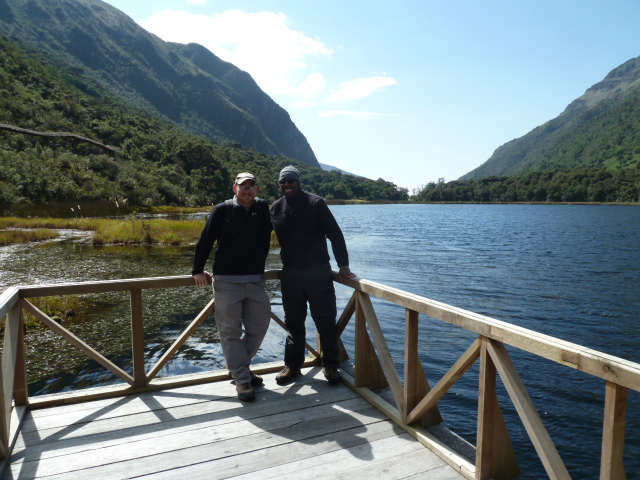
Paul and I in Cajas National Park near Cuenca, Ecuador. Another time, another place, another country

We were all obviously on the same track, weighted down with backpacks. A nomadic network of  travelers saying hello, saying goodbye, and hello again.

In Cuenca, Ecuador, my current location, this network was evident as I exited La Cigale restaurant. A man who held the door for me asked if I had been in the Galapagos about two or three weeks ago. I responded in the affirmative and he said he had seen me on the island. A few more steps through Cuenca’s colonial center and across the street I saw three people I had met two months earlier in Taganga, a fishing village in Colombia. We had sat on the beach there having beers and watching a spectacular sunset. These sort of encounters have been repeated over and over again in just these short three months. Imagine how many people I will have met on the road  and new experiences shared over three years of travel?

One such person is Paul Ford of Austin, Texas. I met cool Texas dude Paul in Cartagena, Colombia, where we chilled, discussed travel plans, partied and got drunk together (celebrating the birthday of another person – Luis – whom I had previously met in Barranquilla, Colombia). Paul and I had some good and crazy times in our travels together and apart.

I left Paul in Cartagena after that crazy night of celebrating Luis’ birthday and didn’t know if I’d see him again. But this is the network and somehow it works to bring travelers together. He sent me an e-mail on the couchsurfing Web site. He said he was in Cuenca, which I had already decided would be my next destination once I left the Galapagos and returned to the mainland.

Now, Paul has sort of become my Cuenca sidekick. We have spent countless hours checking out the city, hiking in Cajas National Park, and meeting new people in the nomadic network. Through Paul  I have met others and introduced him to others. And so the network goes and grows. We meet, we greet, we travel and we meet again. Long term travel has created this global network of friends, all with people, places and many things in common. It’s been simply fantastic.
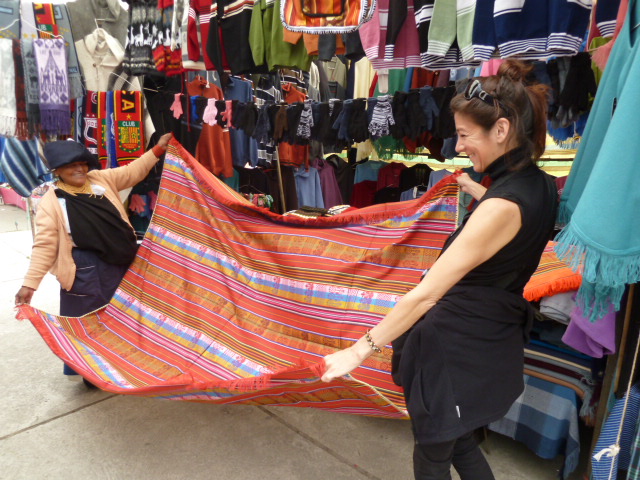
Natalie of Paris, France, my fellow travel companion for a day, tries to decide on a purchase in Sigsig, Ecuador.

The nomadic network works. For the most part, it consists of some of the most open-minded, coolest, most resourceful and resilient people on the planet. Traveling for months or years with everything you own in a backpack is not easy or glamorous. Getting from one place to another takes an awful lot of logistics, energy and will to continue. Most of us are traveling on a budget and sometimes end up sleeping in some scary places. When I’m not sleeping on somebody’s couch through couchsurfing, I am in a hostel or hotel or camping. Some hostels, well, let’s just say you get what you pay for. In Cuenca, after leaving my CS hosts’ swanky digs about 45 minutes by bus outside the city, I landed in a smelly, moldy hostel that lacked housekeeping. The house maid, I was told, simply didn’t show up for work. Sometimes you do what you have to do to stay within your budget. And sometimes because you’ve penny-pinched so much you can afford to splurge a bit, if nothing else, for your own health, both physical and mental.

My smelly hostel cost $10 a night. My current digs, The Victoria Hotel, costs $40 a night, and it’s worth every penny. It has afforded me a good night’s rest, a clean bathroom, a hot shower, and a place to take care of other important business to carry on traveling.

I love my nomadic network. When I leave Cuenca I will probably see Paul and other travelers in some other country, sharing new experiences with new people, largely locals, which also is fantastic. The network is what makes the journey fun and rewarding. It’s about people. It’s about some of the coolest people. It’s me.
Categories: posts | Tags: , , , , , , , , , , | Leave a comment

Cuenca of The People

Its full name is Santa Ana De Los Cuatro Rios De Cuenca. Four rivers flow through it and end up in the Amazon River and the Pacific and Atlantic oceans. It’s high in the Andes Mountains of Ecuador. The world knows it simply as Cuenca. Thousands of Americans of retirement age call it home. And many travelers regardless of age know it as an absolutely fantastic place to visit. I came to Cuenca not expecting much. I had not done my research. This time I decided to let my next destination pleasantly surprise or disappoint me. I extended my stay in Cuenca. That should tell you something, especially since I am anxious to get to Peru. Cuenca and its nearby towns are a feast for the eye. Indigenous women dressed in traditional clothing are everywhere. The city, surrounded by mountains, gives a glimpse back to colonial and pre-Columbian times. There are Inca and Cañari  ruins. Beautiful colonial churches. Plazas and parks. And the spectacular Cajas National Park, a place of incredible natural beauty. And of course, the people make a city. The people in Cuenca are welcoming to foreigners. You wouldn’t have thousands of Americans and ex-pats from other countries living here if that were not the case. All over the city’s colonial center English is heard. If you are seeking a destination other than the usual, visit Cuenca. You will be glad you did. I’m happy I did. Here are some images of Cuenca and the nearby towns of Gualaceo, Chordeleg and Sigsig, all places that are worth a visit on Sundays to witness the indigenous food and arts and crafts markets on full blast. The smells. The colors. The Bustle! The incredible bargains!  Enjoy.

Categories: posts | Tags: , , , , , , , , , , , , | Leave a comment

Love Galapagos, Marry Me

Her name is Anita. That’s at least what she said. She hesitated for a moment and appeared to think about it when I asked her name.  So I was left with doubt as to the validity of the name she offered.

I met Anita on the white sands of Tortuga Beach on Santa Cruz, one of the volcanic islands that make up the Galapagos archipelago. I was crouched down taking pictures of the aquatic iguanas that are unique to the Galapagos, when she was suddenly standing behind me, shooting her own pictures.

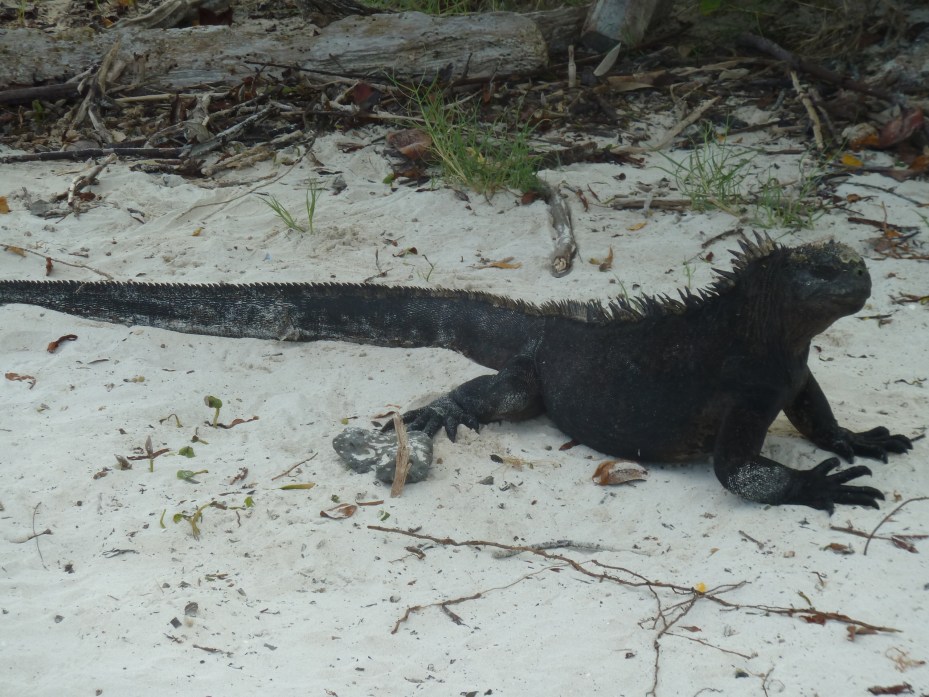
Aquatic iguanas are found in the Galapagos, this one on Tortuga Beach

When I rose, she asked if I could take her picture with the crystal blue waters of the beach as the backdrop, and handed me her camera. She wasn’t satisfied with the first two and asked that I shoot another one. The third one she reacted in a lukewarm fashion.  Hey, I’m only as good as the camera and the subject, I joked.  She laughed and launched into small talk about the beauty of the beach, the iguanas and Galapagos in general. As I continued to shoot pictures, so did she, walking in the direction of mangroves. I stayed put with my iguanas. In just a few minutes, she was way ahead of me on the beach, walking back to the bricked trail that leads to town. I noticed ahead, she caught the eye of some surfers, one of whom – surfboard under his arm – began to talk to her. He was in full flirt mode, from what I could tell from the distance. Then in a matter of minutes, he peeled away from her and rejoined his friends. When Anita stopped to take more pictures of the ocean and the volcanic rocks, I managed to catch up to her. She looked at me and said “it’s so beautiful, these beach”, then said she had just gone kayaking and it was great. We then began to walk back to town together, a very long walk, so I welcomed the company.

What I know about Anita I learned during our one-hour walk on the trail. She seemed to know a lot about the Galapagos. I asked if it was her first time to the islands. She said it was her eighth visit over the years. It was then Anita became interesting person to me: she said she loved the Galapagos and wanted to live on Santa Cruz, and she was looking for an islander to marry. Whoa! Say what? She smiled.

The bricked trail to and from Tortuga Beach

A BIT OF BACKGROUND

The Galapagos is part of Ecuador, but in many ways it behaves and is treated internally as a separate country. Each of the inhabited islands in the chain have drafted very strong immigration laws, some even more stringent than the ones on the books in Quito, Ecuador’s capital. The laws were put in place to prevent the islands from being flooded with people. The immigration laws are mainly in place to stop Ecuadorians from the mainland from relocating to the very desirable lifestyle of the Galapagos.

So unless you were born in the Galapagos, marry someone who is a citizen of the islands, or score a job contract with a company that does business on the islands, you are not allowed to live or work in Galapagos, and that especially means folks from Ecuador who are clamoring to get in.

Anita said she had tried with no success to get a job with a company on the islands. So now she was trying the approach tried by many other Ecuadorians: gain legal residency through marriage.

She was therefore looking for a husband, but she did not wish to make it a business deal as so many have done: pay someone thousands of dollars and pretend you are a couple until all the legal immigration papers are issued and legal residency is gained. Then divorce.

No, Anita was looking to make her marriage real and lasting. So she wanted to marry a Galapagueño – as the islanders are known – but she wanted to be in love with the man she marries and to have children with him. So she was finding it tougher to find the man of her dreams to make three wishes come true: marriage, kids and Galapagos citizenship.

So on her eighth trip she had still failed to meet her future husband. It was the topic that dominated our conversation. When I, for example, invited her to join some friends and me at a party that evening, her response was maybe she would meet her husband at the party. When I told her about my hosts – he a Galapagueño and she half Ecuadorian, half German born in Germany – Anita joked maybe she should meet the woman to ask how she managed to snag an islander husband.  On and on. I thought she’s obsessed!

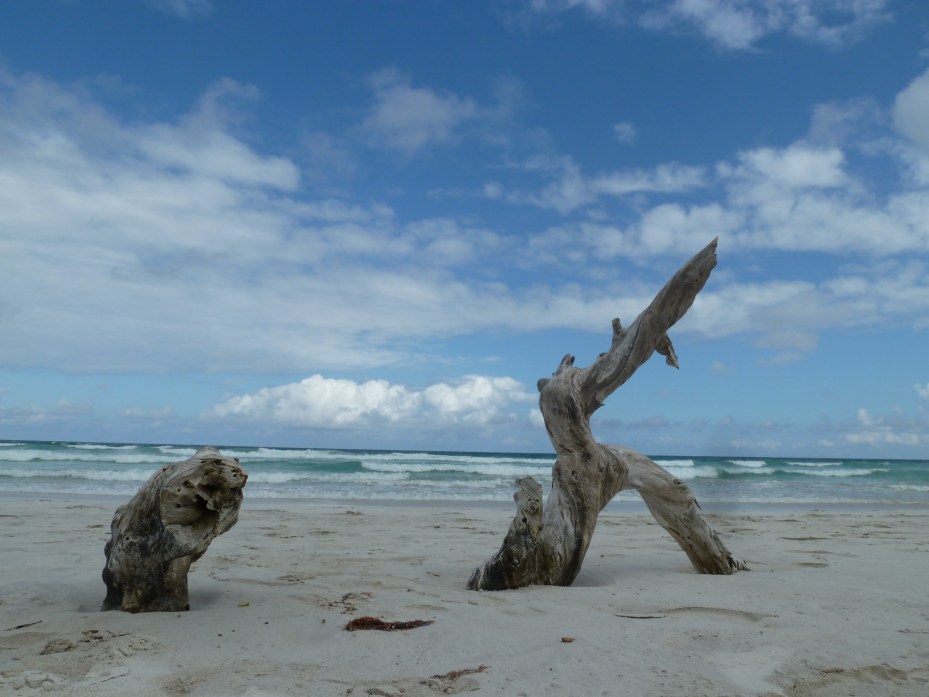
Tortuga Beach in the Galapagos. One of the most beautiful beaches on Earth!

What was immediately apparent about Anita was that she is a fairly attractive woman who gets her fair share of attention. The beach surfers certainly stopped to talk. She said the one surfer who stopped to talk to her on the beach was Galapagueño, but young and dumb. Hey, the woman has standards.

What was not so immediately apparent was why – on her eighth visit to Galapagos – she had failed to find the island husband she so desperately sought. When I mentioned her to men on the island, they of course first asked about her looks then jokingly said “send her to me”.  Galapagueño, men and women, know they are a hot commodity to Ecuadorians seeking to move to the islands. But in recent years, the government has cracked down on such business marriages, checking in on couples and conducting investigations to make sure they are indeed a couple.

Anita, who is from Santo Domingo, a bustling city in the middle of the country, is not willing to take that chance. She wants the real deal.

When I first heard of this whole immigration status thing between Ecuador and Galapagos, I thought it was a rather strange arrangement. Think about it. You are an American citizen, for instance, and by law you cannot freely live in, say, New Jersey or New York or California.

You can’t work in a particular state unless you’ve secured a job contract. And if you simply wish to visit, your visits are limited to a certain number each year. All in the name of preservation and preventing a population and building boom and protecting the fragile ecosystem.

Adding to this interesting relationship is the fact that many Galapagueños don’t identify themselves as Ecuadorians. They say they are Galapagueño, not Ecuadorian, and say they are different culturally and in many other respects to the people on the mainland.

This relationship between the Galapagos and Ecuador surprised me. After all, the world views and treats the Galapagos as part of Ecuador. For that there is no doubt. Within the country, however, it’s a different story.

As for Anita, she plans a ninth visit to Galapagos. Buena suerte with the search for love and citizenship.

Categories: posts, Rants and Raves | Tags: , , , , , , , , , , , , , , | 1 Comment

Blog at WordPress.com.