The Titanium: The tallest building in Santiago, Chile, currently under construction. When completed, it will be more than 60 floors of office and retail space.
I thought I was going to the worst city on Earth. To hear Chileans describe Santiago – as dirty, polluted, ugly, traffic-clogged and a lot of other negatives – is to imagine urban hell. Most of them said the city was not worth more than a couple of days. Some struggled to come up with things to do and places to visit in the city other than the Cathedral. And yet, I am loving Santiago.
I think it’s clearly an anti big city thing. People don’t like big cities. At least the people who don’t live in them. Big cities generally have big problems, such as traffic congestion and public transportation choked with people. Some people see city living as Hell on Earth. They prefer smaller towns with lots of green spaces and such. So a place like Santiago, to most Chileans who live in ideal outlying provinces, urban living is the worst thing imaginable.
When I was in Salta in northern Argentina, I had nothing but negatives about Buenos Aires – from Argentinians themselves. They basically described their country’s famed city in much the same way as Chileans described Santiago. I am glad I did not listen. I was determined to visit Santiago. And I am glad I did. It’s a vibrant place with lots going for it. Sure, it’s not Paris or Rome, but the city has great neighborhoods in which to hang out, sit and have a good breakfast or enjoy lunch. Based on what I had heard about Santiago, I had planned to stay only two days. I’ve extended my stay by two days.
Of course I wasn’t about to have Buenos Aires-bashing Argentinians keep me from visiting the city. I have long wanted to visit Buenos Aires. And I will stay as long as planned, perhaps longer. I guess I am a city person at heart. I love cities. And sure, I like spending time in the great outdoors, in small towns, but I don’t mind urban living and all the insanity that comes along with it.
I grew up hearing all the negatives from Americans about New York, the largest city in the United States. People in other parts of the United States love to hate New York. Even some who have never been there. They’re just not city folks.
So I say to you, dear reader, listen to the criticisms, but take them with a grain of salt and go see for yourself.
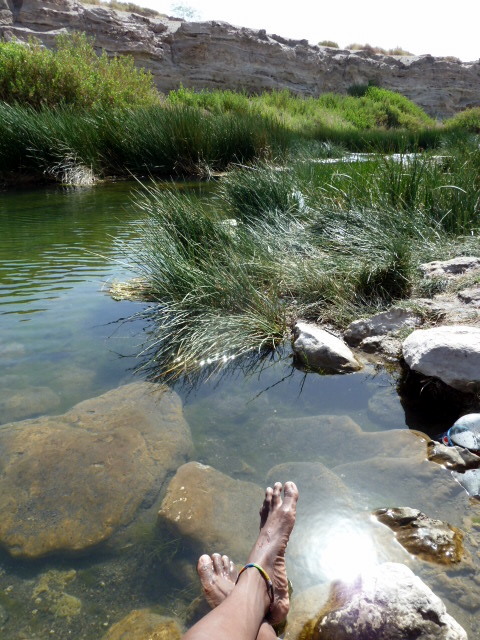
Soaking my feet in the Loa River. The Loa is a U-shaped river in Chile's northern Antofagasta Region. At 440 kilometers long, it is the country's longest river and the main watercourse in the Atacama Desert. The waters are freezing in winter and cold in summer. I tried to venture in, but only did up to my waist. It wends its way from the Andes Mountains through some of the most scenic country anywhere on Earth. It's interesting that it also cuts across the Atacama Desert, the driest place on Earth, with virtually no rainfall. Most days the skies are a bright blue and it's very sunny. I've seen various stretches of the Loa River over a period of time. In some parts, it runs lazily, in others it moves fast, and still in other sections it cascades over huge river bed boulders. It is the lifeline of the Atacama.
Late on Sunday – actually come to think of it, it was already Monday as it was well-passed 2 a.m. – I decided to watch a movie when perhaps a wiser decision would have been to close my eyes and go to sleep. I’ve been staying up late far too much lately, and it hasn’t been doing my rugged good looks any good. <—- humor.
I was already in bed and just about to shut down my laptop and indeed get some rest, but a web page caught my bleary eyes. It was a web page that purports to offer free movies streamed over the Internet. That fact alone was not what really grabbed my attention. What grabbed me gently by the collar was one particular movie featured on the main page – “The Help“. A succinct description of “The Help” from Internet Movie Database [IMDb]:
An aspiring author during the civil rights movement of the 1960’s decides to write a book detailing the African-American maid’s point of view on the white families for which they work, and the hardships they go through on a daily basis.
I had heard so much about “The Help” and had been wanting to see it, but such a movie isn’t easy to find in uninitiated Chile, especially in mining town Calama where I live. I thought if I’m lucky, I would be able to see it in larger, more cosmopolitan Santiago, Chile’s sprawling capital. Or in some other more refined South American city. But here it was on this Internet site, and so I said to myself, okay, I’m game, let’s see if this “free movies” site is legitimate.
After just a click to install an application to view the movie and another click to launch it, lo and behold, the movie started! Well, I wasn’t about to let this golden opportunity slip by. Sleepy or not, 2 a.m. or 4 a.m., it was movie-watching time!
To be sure, “The Help” is about a particularly troubling period in the history of the United States. It’s about racism and the ugliness of post-slavery segregation and its impact on a particular group of women – blacks who worked as maids and who took care of white children when their mothers were too busy playing bridge and gossiping at tea parties, and those white women who behaved as if they owned their maids. These maids, as were all blacks at the time, in which laws were enacted to keep them subservient to whites, were treated worst than dirt. And that’s putting it nicely.
In the United States, mostly in the southern part of the country, blacks were kept as slaves and treated as property. This was the legacy from which African-Americans had risen. This was the struggle they’ve had to endure, even to this day, though there’s no denying much has changed for the better. Heck, we even have an African-American president! Barack Obama’s election stands as a testament to that change, though again, it has also brought to the forefront some pervasive racist attitudes.
In the 10 months I’ve been traveling, I have heard a lot of negative things about the United States. I have met dozens of individuals who have nothing good to say about the United States and its people. I even met some couchsurfers in Medellin, Colombia, who told me when they joined couchsurfing.org, they as a couple had decided they would not host any Americans. They opened their home to me on the recommendation of a mutual friend from Finland. In the end, they couldn’t have been happier with me, we shared lots of good times and we even became friends. In fact, they didn’t want me to leave!
In Latin America, specifically in South America, people have not exactly been shy about telling me how much they detest the United States. I am sure I will continue to hear anti-American sentiments as I continue my journey around the world. I’ve heard it time and time again. I last heard it two weeks ago in Salta, Argentina, from a woman who gave no reason for her hatred of the United States, but I’m sure if I had asked she would have gladly given me plenty of reasons. Just like her, most of these U.S.-haters have never been to the United States. What they know, they know from television and other media. I knew when I started this journey that I would encounter a fair share of U.S.-haters. But I had long decided that I would not play the role of defending my country or engaging in debate. That I would simply listen and generally that is exactly what I do. Of course, I don’t let obvious misinformation go unchallenged, but I’m by no means on some U.S cheerleading squad traveling the globe to debate every activist or leftist that comes along. Let people have their opinion. If they ask a question, glad to answer. If they want debate, I’m not their man.
And yet, sometimes a good fight is irresistible.
In Ecuador, I could not help but to take on a very pro-Hugo Chavez leftist Ecuadorian man who didn’t see the irony in the fact he was standing on a bridge built with aid money from the United States, and criticizing the United States as the most evil country in the world. He had nothing good to say about the United States as we stood on that bridge looking at roiling river waters below. The bridge had a plaque affixed to it. It praised the good graces of the United States Agency for International Development – USAID – but the money had obviously come from U.S. taxpayers, some of whom live in cities and towns with decaying bridges. I pointed out to him that his town had a very nice bridge while there are places in the United States with bridges with questionable safety. I first got a blank stare from him, as if puzzled why that is, and then this: “Oh, well, how much did this bridge cost the United States to build? A million? Two million? Maybe $3 million? Whatever amount it was, it’s nothing for the United States! Just a drop in the bucket considering the United States’ economic resources.”
It was at that point I decided there is absolutely no point in trying to convince people when their minds are made up. After all, did he know what that bridge meant to the people of his town? To Ecuador? Perhaps even to its economic growth? Did he stop to think what that “drop in the bucket” could do for a kid in a struggling school in the United States? Had he even considered that the United States sends millions in economic aid to Ecuador and billions more around the world? Can a person be so closed-minded and ungrateful?
After watching “The Help”, I stayed up a bit later thinking about all this. I thought I of all people have every right to denounce the United States, for the history of my people in the United States hasn’t exactly been a parade. At one time in her life, my mother was “the help”. But she managed to advance her education and get a better job in the medical field. That’s the beauty of the United States. I recognize that the United States is not all evil and no good. Sure, even Americans would admit there are some things we are not proud of, but point me to the nation with no scars in its past. We live and we hopefully learn.
Missteps and all, I love the United States. I, of course, don’t support everything my government does, only a non-thinking fool does that. But as I travel, I’ve also seen the goodness of the United States, such as in the faces of Peace Corps volunteers in Peru, placing on hold their own lives to help some struggling village far from home. I see it in the volunteers working with a myriad of volunteer organizations around the world. I see it each time there’s a natural disaster and the United States is the first to answer the call for help.
While I don’t intend to be a cheerleader for my country, I will sing its praises if asked. This, despite the history of blacks in the United States. I certainly have cause to be critical of the United States, just freshly having been reminded of the struggles of “the help”, but the United States is much more than a string of negatives. Then, on my journey, I intend to build bridges.




 Mike Tends To Travel
Blah blah blah (Comments)