Today is my birthday. It’s the first of at least two more I will mark outside the United States. This one I am spending in Calama, Chile. In which country will I find myself in when the other birthdays hit, I don’t know. Could be Moscow or Mumbai. Could be Bangkok or South Africa. Could be the Middle East. No matter, wherever I am, I hope to be surrounded by a bunch of local people simply having a good time, as I have done in Chile. It was really a fantastic birthday and I thank all my Chilean and expat friends who made it happen.
With you….
….still
on a journey….
Friends surprised me with this birthday cake in Chile. It was chocolaty delicious!
Richard Nixon and his adversary Leonid Brezhnev. Chile lost in the translation?
Chileans have their own 9/11. For many Chileans, September 11, 1973 will be the date that forever will live in infamy. Theirs happened 38 years ago, a full 28 years before the 9/11 terrorist attacks in the United States that shook the world to its core and today overshadows anything that happened on that day, including on Chilean soil. But to Chileans, their own 9/11 is one huge sad chapter in their history, and one that continues to cause much pain almost 40 years after.
On September 11, 1973, President Salvador Allende was overthrown in a bloody military coup. Dozens of people were killed that day, but thousands died in the days, months and years that followed. The dictatorship proved more harmful and certainly more deadly to Chilean society than anything Allende’s duly elected government had done. Growing dissatisfaction at home with Allende’s socialist policies, lagging economic conditions, and cozy relationship with communist Cuba led to the coup. But external forces as well played a key role in Allende’s overthrow and the installation of the military dictatorship. In the midst of a Cold War and an arms race with the Soviet Union, the United States worried that the Soviets would gain yet another foothold in Latin America.
U.S. President Richard Nixon ordered the Central Intelligence Agencyto step up operations in Chile to hasten the removal of Allende, who as part of his socialist agenda had nationalized companies – including the mining industry – partly or wholly in the hands of American and other foreign interests. American companies, such as ITT Corp., also spent millions trying to derail Allende.
Los Desaparecidos
ITT was a majority owner of the Chilean telephone company and openly worried that Allende would nationalize it as well. That would mean millions in losses for the U.S.-based corporate giant. So internal and external forces worked hand in hand to topple Allende. And so a ruthless dictatorship came to be. The human rights violations are immeasurable.
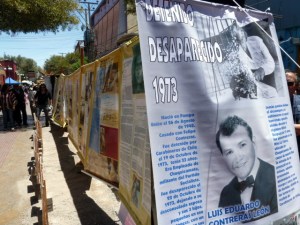
Every year, Chileans observe the somber anniversary with calls for justice for the men and women collectively known as los desaparecidos – the vanished. Over the course of the 17-year dictatorship, thousands of these individuals were executed, murdered, tortured and made to disappear. They were often picked up at their homes or place of work and never seen or heard from again. Some were buried in unmarked graves in the desert.
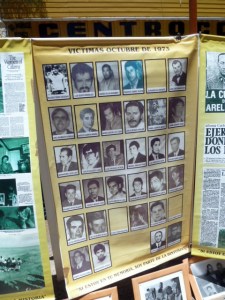
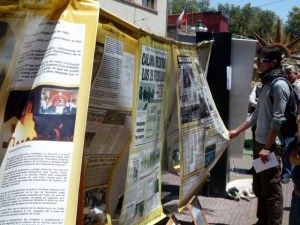
In Calama, where I currently live here in Chile, I was walking in the center of town when I came across a display and a group of women known as the Women of Calama. These are women whose husbands, sons, fathers were executed by the military regime or made to disappear. One of the women, a black and white photo of her father pinned to her chest, took the time to tell me about the display and the reason for it.
Reading...remembering
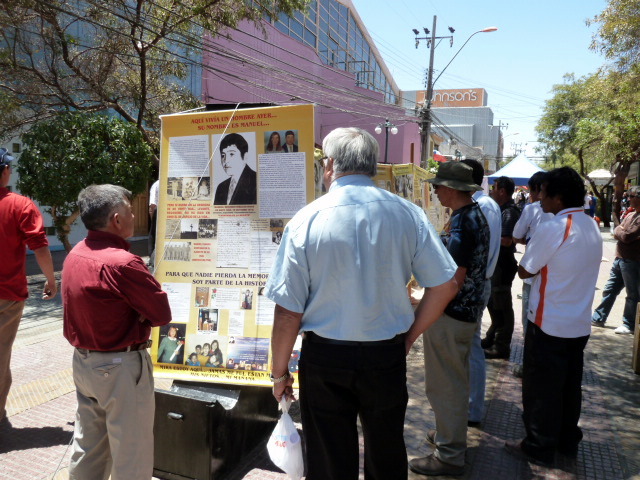
She said that on October 19, 1973, just over a month into the dictatorship of Gen. Augusto Pinochet, 26 men from Calama were rounded up – her father included – and were never heard from again. Some were executed while the whereabouts of others was never again known. The Women of Calama each year call for justice for the individuals whose lives were cut short by the military dictatorship led by Pinochet. Annually in the center of Calama they display the photos of the men and items that tell their stories, such as family photographs, documents and news articles.
On the day I saw the moving display, hundreds of Chileans gathered around to see it. Children learn about the events of 1973 and beyond in Chilean schools, she said, so there’s little chance of Chile’s youths not knowing that part of their country’s history. Still, the Women of Calama dust off the displays each year in October as a way to remember those killed.
The woman told me that the wheels of justice move extremely slowly in Chile and many who took part in the murders and torture of innocents are yet to be brought to justice. She said some of the accused are old and make all sorts of claims of senility to avoid prosecution.
Some say Chileans don’t like Americans for the United States’ part in bringing the dictatorship to power. I can’t say that I blame them, if that’s indeed the case. But in my three months in Chile, I have not seen any evidence of that. If anything, I’ve been shown nothing but kindness once Chileans learn I’m American.
Certainly, the United States wanted Allende gone. But Chileans also wanted his ouster. Those two forces obviously didn’t know that a military dictatorship that would go around conducting assassinations even beyond its borders would assume control. Herein lies the lesson for the United States and others backing the overthrow of longtime leaders in places such as the Arab world : Be careful what you wish for.
Out of breath, we reached the top of Incahuasi. It wasn’t a very steep climb to the island’s peak, but the light-on-oxygen altitude made flatland lungs work harder.
Like a darkly dressed sentinel standing conspicuously in a seemingly endless expanse of snow, Incahuasi juts toward the sky, watching over one of Earth’s most breathtaking beauties – the mystical Salar de Uyuni. At more than 11,000 feet above sea level, Incahuasi – which in the Quechua language of the ancient Incas means “Inca House” – is but one of several islands in the middle of the Uyuni salt flats, the largest salt lake in the world. Not many outside of Bolivia realize that the Uyuni salt flats is actually a lake, because it’s dry for much of the year. Under that sea of salt, however, rivers run year-round and in places bubble to the surface, creating circular patterns in the otherwise smooth terrain.
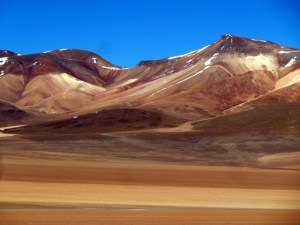
Bolivia's beautiful mountains
But come summer in the Southern Hemisphere, the Uyuni salt flats is under water, rendering Incahuasi unreachable by the fleet of four-wheel drive vehicles that otherwise normally speed along the blindingly white-as-snow salt bed. Even submerged – perhaps more so because of the mirror-like effect the water creates – Uyuni takes your breath away. Any air I had left from that climb up Incahuasi was knocked right out of me by the stunning landscape before me. At the top of the island, I found a spot away from the other mesmerized tourists and sat to catch my breath. But instead, if only for a brief moment, I unwittingly held my breath as I caught my first glimpse of Uyuni from this amazing vantage point on Incahuasi.
Happy to have made it to the Uyuni salt flats, Bolivia
Dear reader, I don’t care what your religious views are, and I certainly don’t try to impose whatever views I have on you, but let’s talk spirituality for a brief moment. This piece of Bolivia that encompasses Uyuni has been touched by the hand of a God – but if you prefer – some powerful – and perhaps playful – force. This salt lake, nearby lagoons, mountains, volcanic geysers, rock formations and deserts were not formed by accident. Someone or some thing more powerful than man did this. I sat on a rock contemplating the thought that force that created the Earth, stuck around this area of Bolivia for a nice stretch molding and creating what we see today in this part of Bolivia: a lagoon with waters so richly red it looks like the blood of thousands has been drained in it; other vivid-colored lagoons with three species of countless pink flamingos; mountains and volcanoes that humble us mere humans; mind-boggling layers and formations of ice and snow on high plain desert sands; liquefied lava-gurgling volcanic geysers belching big puffs of steam across a vast expanse; exotic and whimsical wildlife found nowhere else on Earth or in few other places. If you are not transported to some spiritual place in your brain while contemplating all that is Uyuni, you can’t possibly be alive.
yeah....really happy 🙂
Before I sat on that rocky island covered with coral and cacti some more than 900 years old, I had the privilege to stand in the middle of the salt flats and absorb its wonders from its very midst. The skies were overcast, unusual for this time of year I was told, but it gave Uyuni an even more wondrous ambiance.
With fellow English teachers – American Zac and Chilean Angello – and Spanish couple Alonso and Maria Alba, we set out to discover Uyuni with our Bolivian guide David. We signed up in San Pedro de Atacama, Chile, with a tour agency, Atacama Mistica – also operating as Tierra Mistica – after consulting with several other tour agencies. Mistica seemed the most knowledgeable and trustworthy. With the exception of a couple of glitches – a mix up with the return bus to San Pedro at the border, and a previously undisclosed $10 charge for hot showers at the hostel – we were extremely pleased with Mistica. But we were especially pleased with our guide, David, who kept things running smoothly and yet didn’t make the tour feel as if it were some sort of marathon and that we were on a time schedule.
One view from Incahuasi
We opted for the 4-day tour, departing on Friday morning and returning to San Pedro on Monday. The total cost of the tour was $160. That included three meals a day, lodging, and transportation. It did not include fees to Bolivia’s national parks, about $20. We had considered the option of traveling to the city of Uyuni on our own – by bus – then perhaps hiring someone in that city to take us to points of interest. But in the end, the tour emerged as the better, more sensible option.
At 8 a.m., we were met at Mistica’s office and were driven in a van to the Chilean customs and border control office in San Pedro. Then another 40-minutes later we reached the Chile-Bolivia border. As I expected, things ran much smoother on the Chilean side of the border. On the Bolivian side, confusion and corruption reigned. All largely because the Bolivian border control officers are corrupt and looking to shake down tourists for cash with bogus demands for random fees.
Inside the salt hostel. Yes, it's made of salt and salt covers every inch of the floor
When we tried to re-enter Chile from Bolivia, for instance, one of the Bolivian guards tried to get Angello and the Spanish couple to pay an extra $15,000 Chilean pesos ($30) each when it was clear that they did not need to pay anything. He then pulled the two Americans in the group aside – Zac and I – and led us to a backroom – a kitchen – where he stated that all our documents were in order and there was no problem. One thing was missing, as he plainly put it: money for his own pockets. Without batting an eye, he asked if we had any money for him. He wanted us to give him money – out of sight of the others in line waiting to be processed out of Bolivia. I told him we had paid all the necessary fees and we weren’t going to pay any more money. When he again asked, in a much firmer tone I refused. He got the message. He said okay, hurriedly returned our passports – he was so nervous that he mistakenly handed me Zac’s passport after looking at the pictures in the two passports. I took it and simply handed it to Zac. The Bolivian border cop the sent Zac and I on our way. He, however, returned to the growing line of people and continued to insist that the Spaniards and Angello pay some inexplicably obscure fee. That demand was resolved after they, too, held firm against paying anything beyond what Bolivian laws state and our tour company intervened. Lesson learned: Hold firm, just say no to corruption!
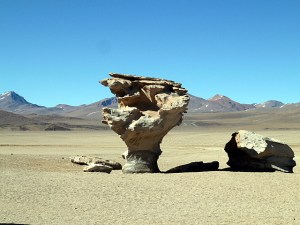
El Arbol de Piedra - The Stone Tree - in Bolivia's Altiplano - high desert
Despite the corrupt Bolivian border cop; a two-day bout with food poisoning or some other virus; a bit of trouble breathing at almost 16,000 feet above sea level (5,000 meters); freezing temperatures; hardly a good night’s sleep; four days without a hot shower and two with no shower at all; and punishing wind and desert conditions, Bolivia was incredibly magical and even worth enduring the hoops to get there. (By the way, my fellow Americans, instead of paying $135 for a 5-year visa to enter Bolivia, opt for the cheaper 3-day visa worth $40 – unless, of course, you plan multiple exits and entries or longer stays in Bolivia).
For nature lovers, I highly recommend Bolivia. It’s the most inexpensive country in South America and certainly one of the cheapest in the world. The overwhelmingly indigenous population isn’t exactly warm and friendly to outsiders, and they even look upon strangers with a wary eye, but once engaged they are friendly enough.
The air temperature was at least at the freezing point but the water felt like summer!
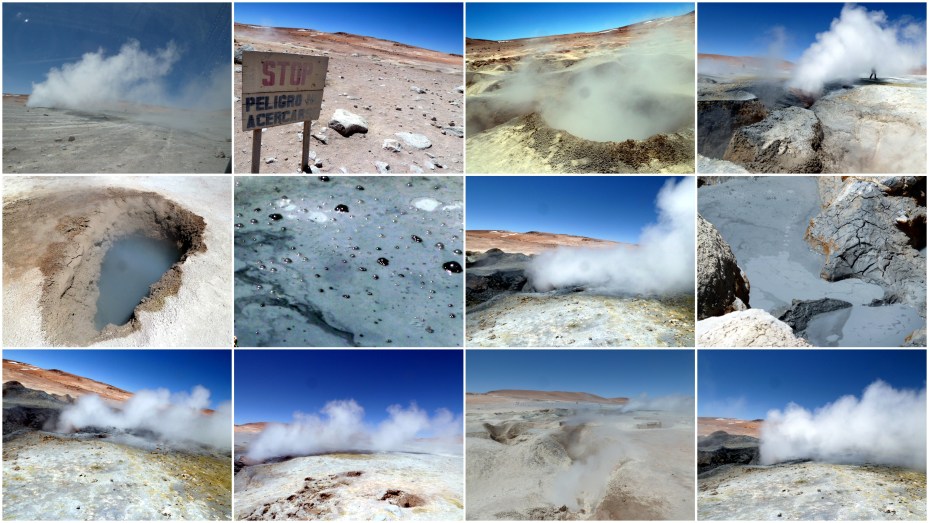
SENSE OF DANGER: Bolivia's boiling and steaming volcanic geysers
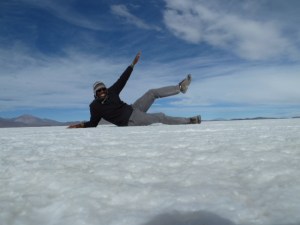
UYUNI CAMERA TRICKS: I appear shrunken and on top of the Coca Cola bottle by just placing the bottle closer to the camera and me stepping back and posing
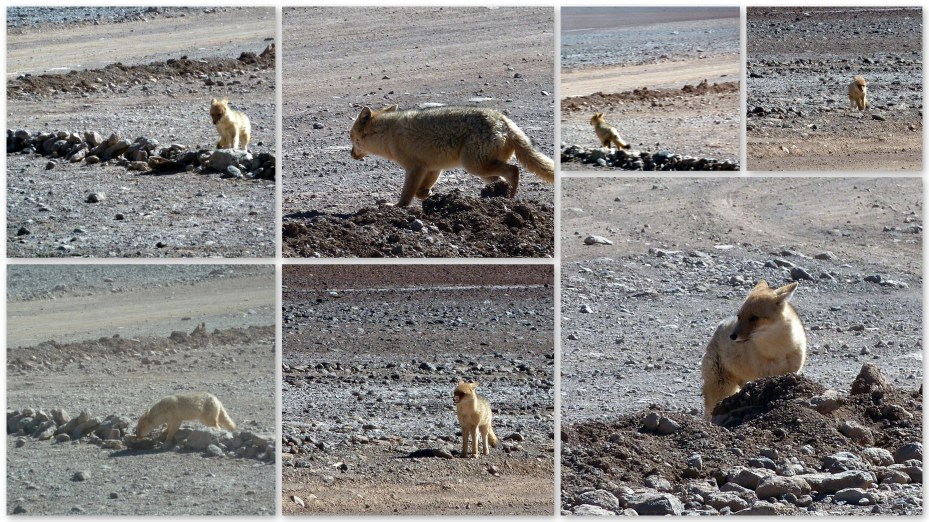
DESERT FOX: Snapped photos of this desert dweller near the Chile-Bolivia border
ICE ON SAND: What's left of a snowstorm in the high desert of Bolivia. I'm at nearly 16,000 feet above sea level here. Bad idea running up this slope.
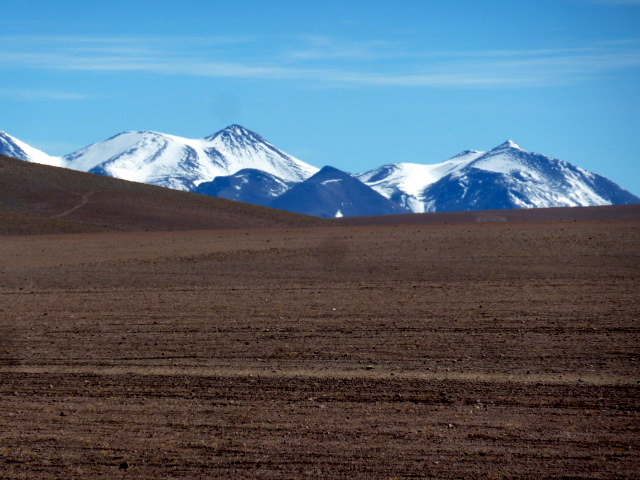
The Andes Mountains in Bolivia
One way to go across Uyuni salt flats
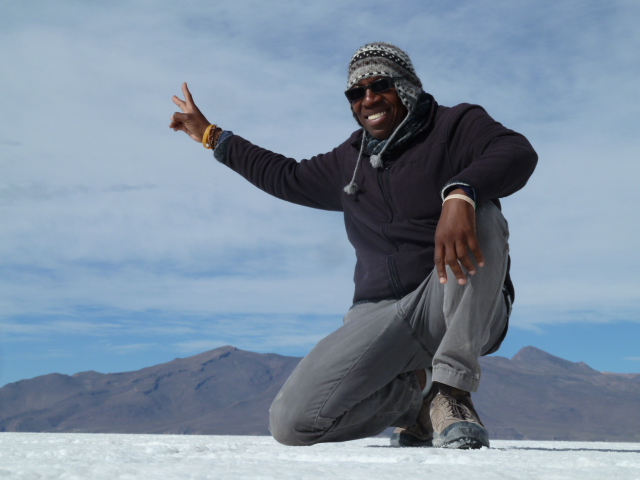
Uyuni plays optical tricks. Now I look bigger than the mountains
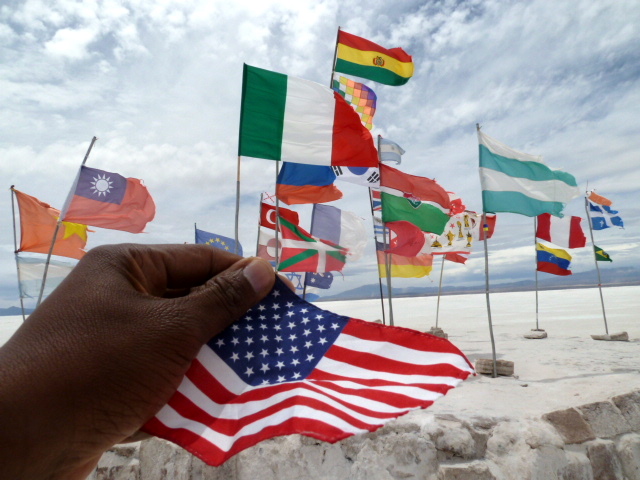
Flags from several countries near the first salt hotel in Uyuni, now a museum. But where's the Stars & Stripes?
Representing!
Zac and Angello doing a great job of keeping a low profile at the Bolivian border crossing













 Mike Tends To Travel
Blah blah blah (Comments)